


A stock I have followed for years without ever owning it is the Swedish company Vitec. At 600 SEK a share it was loved by fintwit and every quality investor out there. Now it sits at 247, and it seems like nobody really mentions it much anymore.
Lately, I have been thinking about whether I should have most of my money in the Nordic markets. After all, I am Norwegian, and I am hunting for companies more “close to home”.
The question is whether Vitec is a worthy replacement for my largest position in Canada.
If you’re in a rush
Vitec owns 49 small software companies in 13 countries. The programs these companies build are an important part of everyday life for pharmacies, real estate brokers, car workshops and churches. 86 percent of revenue is recurring, meaning it comes back predictably every single year (Q2 2026, IFRS restated).
As I said, the stock was loved back when the price reflected more than 60 times annual earnings. Now, thanks to the SaaSpocalypse, it is unpopular at 21 times (R12, IFRS). The fall from the top was 642 to 212 SEK, but the company has kept delivering the goods.
The outcome comes down to one thing: the return on the next acquisition krona. The base itself is a fortress, but the “engine” has to keep delivering.
Status: Wait-and-see, with a trigger around 190 SEK. But I am considering a starter position at around 240 SEK a share. Time will tell. You can see all my portfolio moves if you are a paid subscriber.
My history
I have followed Vitec for a long time. It used to be one of those companies people called a Constellation in miniature. But I never bought it. Honestly, that was pure luck.
So why does it interest me now?
The rational reason is that the price has halved while owner earnings per share have kept growing, and when that happens, the name has to be analyzed again.
The emotional one: I want to come home. I have noticed that I want Nordic companies where I can read the reports in the original language, with accounting rules I understand, and businesses I can actually visit. The culture is usually easier to understand, and information is easier to get hold of (insider buys and sells, for example).
Vitec could be the start of that shift.
But I already own Topicus in Canada. Same business model, stronger capital-allocation culture, listed in Toronto but with its heart in the Netherlands.
So, do I buy Vitec, or will it turn out that this whole deep dive just leads me to add to Topicus?
Two physicists in Umeå
In 1985, two researchers at Umeå University, Lars Stenlund and Olov Sandberg, sat writing energy-calculation software in Turbo Pascal for property managers who wanted to cut heating costs.
Stenlund was CEO from 1990 to 2021, and through that whole period he built one niche at a time, one acquisition at a time, and never sold what he had bought.
Out of that culture came the promise that is now part of the moat: Vitec is a permanent home. A founder in Horten or Herning who has spent twenty years on his industry software, and who has to choose between Vitec and a PE fund with a five-year horizon, more often picks Vitec. Because it builds trust that when they buy something, they commit to that purchase for the long haul.
And Stenlund still sits as chairman with 1,170,000 A-shares and 224,476 B-shares as of 28.02.2026. That works out to roughly 345 MSEK and 19 percent of the votes.
HYPOTHESIS: the culture survives the handover from founder-CEO to finance-guy-CEO.
MONITOR: departures among unit managers and VPOs, and whether the “permanent home” language survives in the acquisition announcements.
Atomic Take: the culture is real and has been built up over time.
Falsifier: a resale of an acquired unit would puncture the promise overnight.
How does Vitec make money?
For example: a pharmacist in Odense opens Vitec Cito. She doses medication for a nursing home, and the system keeps track of drug interactions, journaling requirements and reimbursement. Switching a system like that means half a year of retraining, risk of dosing errors and so on. So switching it out is the last thing anyone wants to do.
Apply that same example to 27,500 customers across 49 niches in 13 countries, from the real estate broker in Trondheim to the car workshop in Utrecht, and you have Vitec.
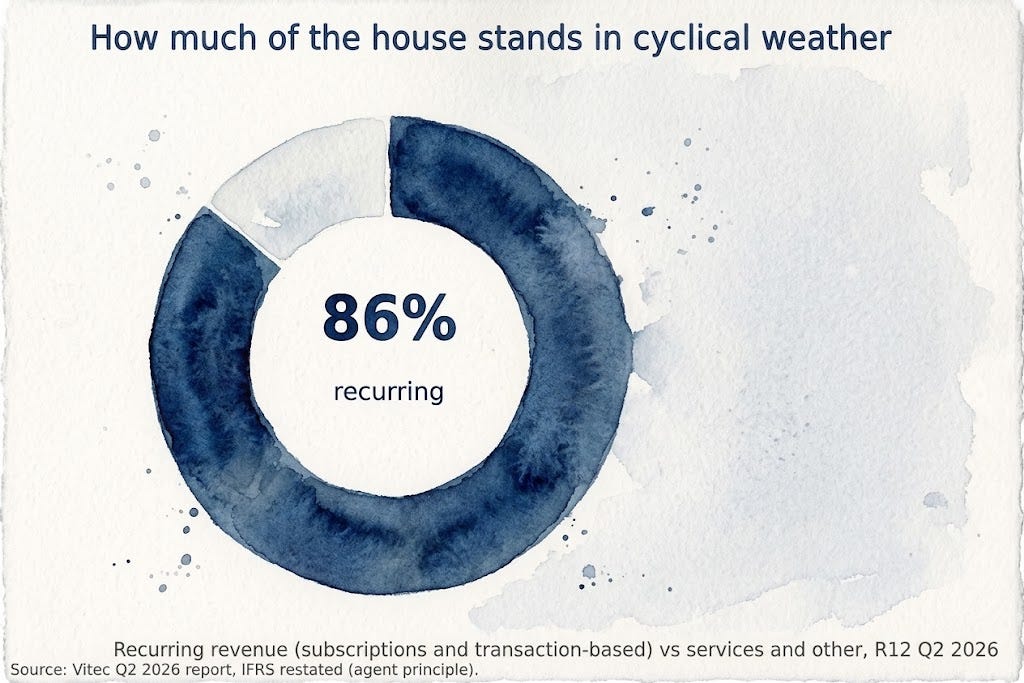
86 percent of Vitec’s revenue is recurring, and what I especially like is that no single customer accounts for more than 1 percent of sales.
Vitec’s revenue over the last twelve months is 3,525 MSEK.
Atomic Take: Vitec has built a portfolio of small monopolies on boring, mission-critical workflows.
Falsifier: if I see organic subscription growth below 3 percent two quarters in a row, that would tell me the base may be starting to crack.
The pond and the competition
Vitec sits on the Large Cap list in Stockholm, is covered by nine named research houses from Carnegie to SEB, and has more than 13,000 shareholders. There is no neglect edge here. If there is an edge, it has to come from the price and from patience, never from being alone in seeing it.
Vitec’s market cap today is around 9.9 billion SEK.
Vitec’s competitors are interesting because they rarely compete for the customers. Our pharmacist in Odense is not getting a visit from Visma tomorrow. They compete for the companies: Visma, Main Capital, Volaris, the PE funds, and yes, Topicus itself, all bid on the same Dutch and Nordic software houses.
The grizzly test
I run the grizzly test on everything I analyze: could a competitor with money outcompete Vitec?
My view is that Vitec’s customers cannot leave, or do not want to leave, because the software made by the companies Vitec owns is usually a critical component of daily operations. Whether we are talking switching costs, legal requirements and so on.
What is left for the owners?
So 3,525 MSEK comes in every year. But what do I, as an owner, actually end up with?
Vitec has its own operating measure called Cash EBIT. That measure expenses every single krona of capitalized development work, which is about 440 million Swedish kronor a year. So it is actually a stricter number than their own IFRS result. Plenty of companies dress their numbers up. Vitec does the opposite, and I like that very, very much.
Cash EBIT over the last twelve months: 871 MSEK, which is a 25 percent margin.
Then I subtract what disappears before the money reaches me. The banks take 108 MSEK net in interest. The share savings program costs around 42. The taxman takes 23 percent of the rest. That leaves me with roughly 556 million, or about 14 kronor per share.
Munger, by the way, told us to substitute the words “bullshit earnings” every time we see EBITDA. And that is why I never use it myself either. No point arguing with the legend himself.
Does the operation need much maintenance, then?
No, almost none actually. Tangible investments run around 24 million Swedish kronor a year, against operating cash flow of 1,143 MSEK. The company gushes cash. Then it spends all of it on new acquisitions.
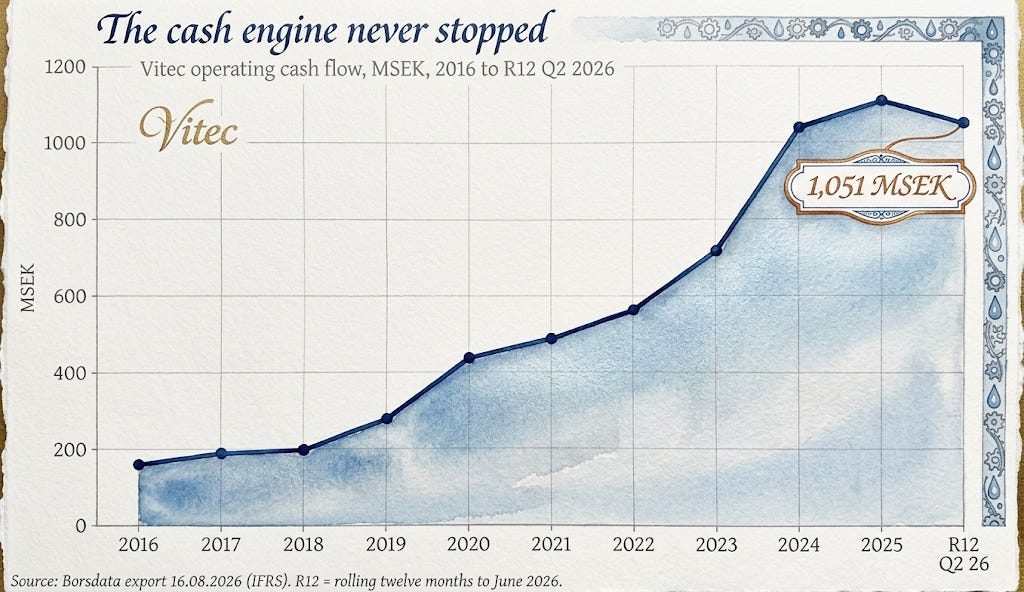
Atomic Take: a 25 percent cash margin on 86 percent recurring revenue, measured with the company’s own strictest yardstick.
Falsifier: if capitalized development starts growing much faster than the amortization on it, costs are being moved into the balance sheet and Cash EBIT loses the honesty it has today.
The accounts

Let’s check the balance sheet first.
Net interest-bearing debt is 3,013 MSEK.
Add in earnouts (contingent payments to sellers) of 627, and the real obligation is 3,639 MSEK.
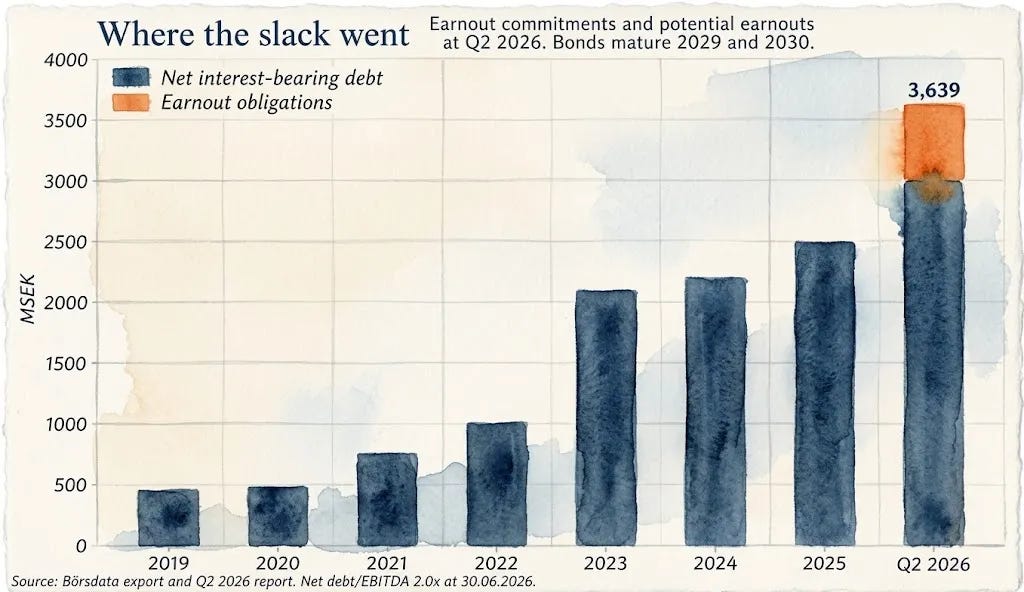
Bonds mature in 2029 and 2030. Net debt to EBITDA is 2.0 times. That is normal for serial acquirers, but a completely different book from the Vitec of 2019. None of this is dangerous today. But it eats up the slack you need in a bad year.
Now to what I think is the best-hidden sentence in the quarterly report:
The last twelve months contain 185 MSEK of impairments of intangible assets. They are booked against almost exactly the same amount of income from reversed earnouts.
The net effect on the result is zero.
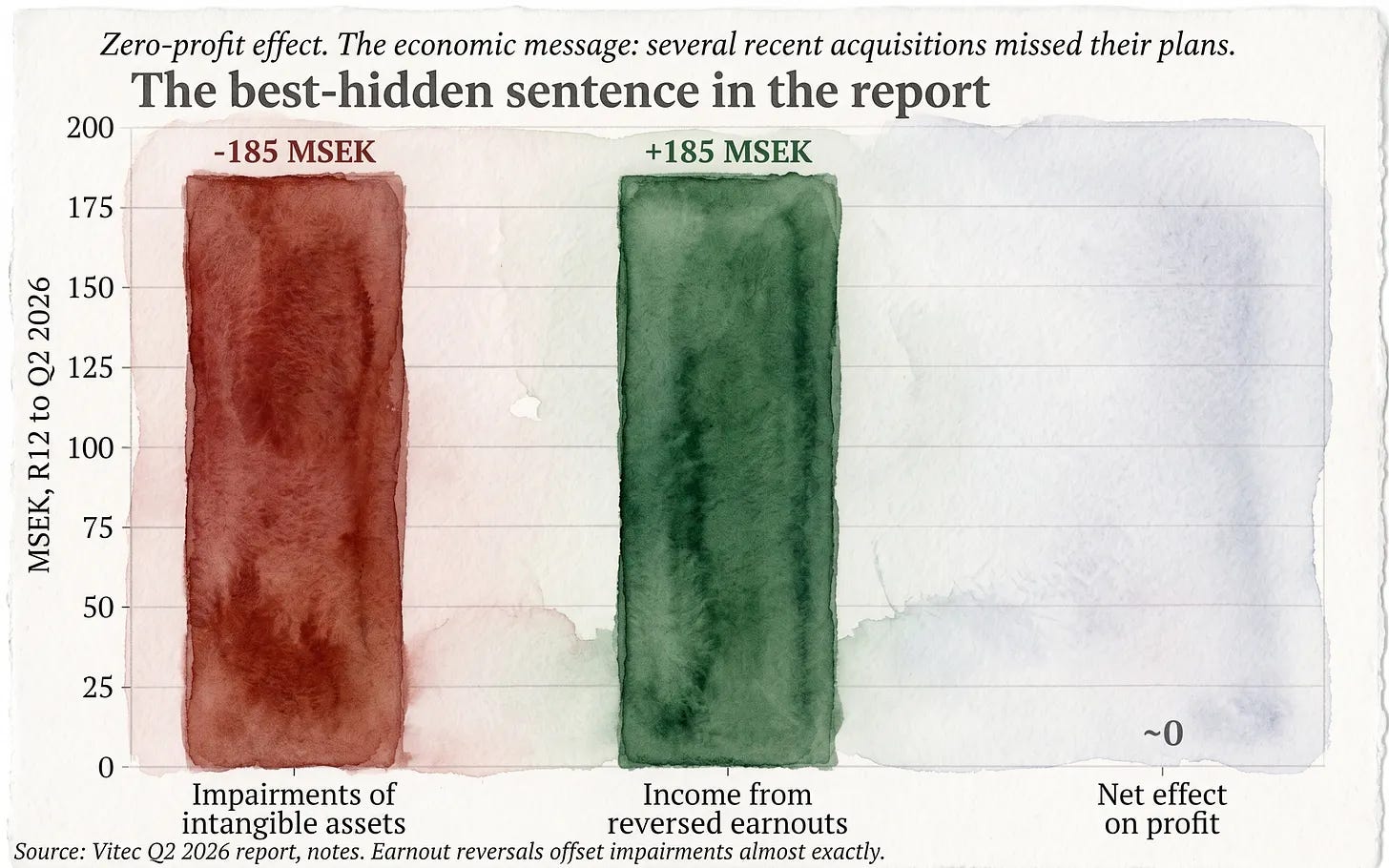
But think about what it actually means. When an earnout is reversed, it means the acquired company missed the plan the seller was supposed to get paid for reaching.
And the impairment next to it is the auditor agreeing. So the accounts are admitting that several of the last few years’ purchases have underperformed.
The cash flow, on the other hand, is clean. Free cash flow by the company’s own definition is 594 MSEK, which is 1.28 times net profit.
Atomic Take: a clean cash machine that has borrowed its way to a pace it now has to defend.
Falsifier: net debt above 2.5 times EBITDA, or interest coverage below 5 times. Then I change my status regardless of the share price.
The people at Vitec
Lars Stenlund we already know a little. The physicist, the chairman, 345 MSEK in shares. He bought 2,000 B-shares at 223.58 in June 2026. A symbolic purchase of 0.45 MSEK, I would say, so I do not put too much weight on it.
The boss himself is Olle Backman, in the seat since 2021. He is a finance man from Uppsala, was CFO of Vitec before becoming CEO, and ran the electrical installation company Eitech before that. He owns 53,674 B-shares, roughly 13 MSEK.
Under his leadership, revenue has gone from 1,571 to 3,525 MSEK, earnings per share from 6.14 to 11.68 kronor, and the Cash EBIT margin from roughly 19 to 25 percent.
But the debt has also grown on Olle’s watch. From 754 to 3,639 MSEK including earnouts.
And the prices paid for acquisitions have climbed steeply. My estimate of the return on all capital put to work since 2021 is 8 to 11 percent pre-tax. My requirement is 15...
And then the test I rank highest of all for management: do they dare to make unpopular, correct decisions?
Hmm, not really. Pausing the acquisitions, or buying back a halved share instead of bidding 15 to 19 times EBITA for the next company, would have cost Backman the applause he gets from the growth.
The buybacks are, in my opinion, symbolic.
Atomic Take: honest people who report hard and spend soft.
Falsifier: another year of rising acquisition multiples without a pause. Then my reading moves from “suited with reservations” to “not suited”.
Vitec’s future
Where is Vitec in fifteen to twenty years, assuming we still have competent management and avoid drama along the way?
I think they will be sitting on a few hundred niche software houses, with maybe 12 to 15 billion SEK in revenue and at least as good a cash margin as today.
The destination, in my eyes, is clear and large. But it depends on execution. The road there runs through purchases that have to be made at prices that actually earn a return.
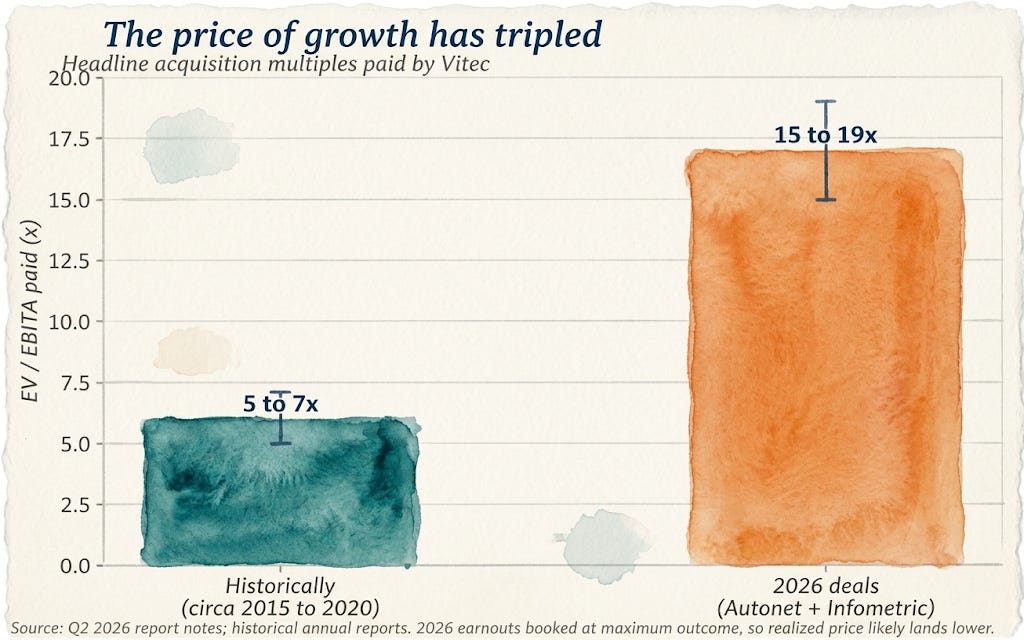
And the price of the road has already gone up. This year’s two acquisitions, Autonet and Infometric, cost around 945 MSEK for a run-rate of roughly 50 MSEK in EBITA. That is a headline multiple of 15 to 19 times. Historically, Vitec paid 5 to 7 times.
(One important detail: earnouts are booked at their maximum outcome, so the real price will probably end up lower.)
HYPOTHESIS: today’s multiples are cyclical. PE money gets more expensive one day, and a sluggish seller’s market hands the patient buyer better prices in one to three years.
MONITOR: implied EV/EBITA on every single quarter’s acquisitions.
Catalyst?
As far as I can see, only time. Quarter after quarter of earnings growth, until the market gets bored its way back to trust. Buffett wrote that the best purchases are met with yawns. Well, at least the yawn is in place here.
Atomic Take: the destination is clear and visible. I doubt Vitec disappears off the map anytime soon.
Falsifier: four quarters in a row of acquisitions above roughly 12 times EBITA. Then the runway is effectively closed, and the company has to be valued on organic growth alone.
Head to head: Vitec versus Topicus
Now to the question this whole deep dive is really about for me personally. I own Topicus. Same business model, vertical niche software bought to be owned forever.
Both stocks, by the way, are roughly halved from their tops. Topicus from 199 to about 100 CAD, Vitec from 642 to 247 SEK. The whole model has been through the same roller coaster.
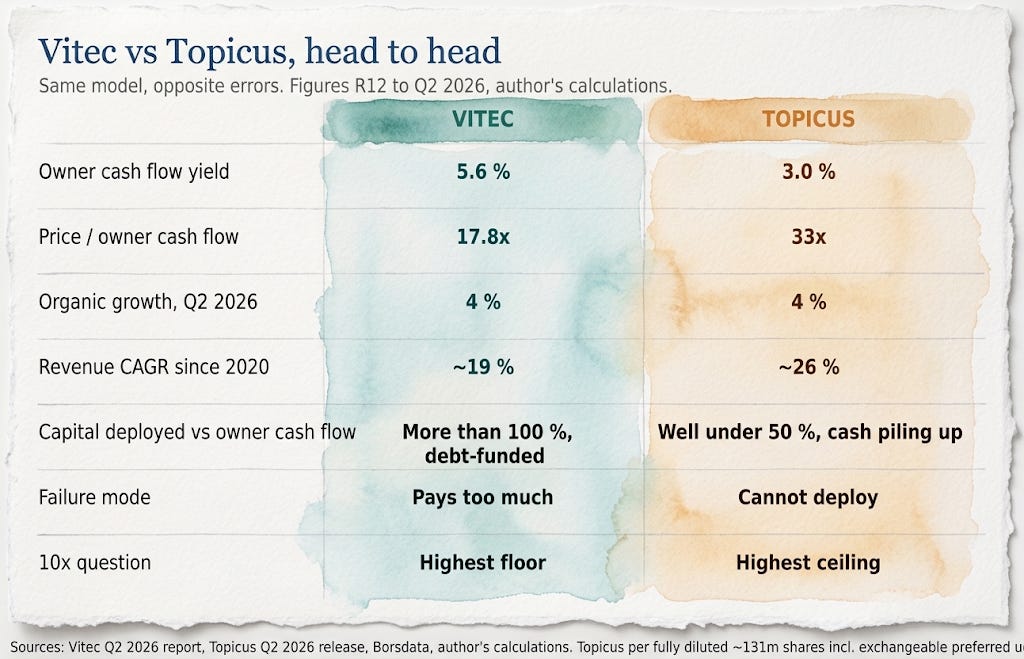
The dividing line is the return on the next krona. Topicus inherits the Constellation family’s return requirements, and you can see the discipline in the numbers. In all of 2025, Topicus spent only around 110 to 120 MEUR on ordinary VMS acquisitions. In the second quarter of 2026, just 40 MEUR. That is pocket change against a free cash flow to shareholders of 254 MEUR over the last twelve months.
Which means: Topicus simply says no to the prices Vitec says yes to.
The flip side of that discipline is that Topicus’s money piles up.
Topicus solved that in 2025 by buying a large minority stake in Poland’s Asseco, for more than half a billion euros, partly debt-financed.
Creative, and fully in the Constellation tradition. But it is also an admission that ordinary acquisitions at the old prices are hard to find for everyone now.
So Vitec pays too much. Topicus can’t get its money deployed.
I HAVE to admit I prefer the latter.
What about growth? Organically they grow strikingly alike: 4 percent for both in the second quarter of 2026, with price increases as roughly half the driver in both places. The difference is the acquired growth.
Topicus has grown revenue 26 percent a year since 2020, against Vitec’s 18 to 19. And free cash flow to shareholders at Topicus grew 23 percent in 2025 and 24 percent in the first half of 2026.
The engine is stronger, and it “runs on a bigger tank” too. Topicus has the entire European continent plus the Asseco option. Vitec has the Nordics plus selected European niches.
But it is when we look at the two companies’ prices that the story takes a different turn.
Because here, the picture flips. I have tried to calculate the same way for both, and to do that I have to explain a trap in Topicus first.
Topicus reports its own cash flow measure called FCFA2S, free cash flow available to shareholders. It is their version of the owner earnings I calculated for Vitec. Over the last twelve months it is 254 MEUR.
The trap is the share count.
Only 83 million Topicus shares sit on the exchange. But the founding Joday family and Constellation additionally hold preferred units that can be exchanged one-for-one into ordinary shares at any time, and that have a claim on exactly the same cash flow as I do.
If I only count the listed shares, the stock looks much cheaper than it actually is. So I count all of them: roughly 131 million shares fully diluted.
Then the math becomes simple. 254 MEUR divided by 131 million shares is about 1.93 EUR of cash flow per share. The price is 101.93 CAD, which in euros is 63.50. So I am paying 63.50 to own 1.93 of annual cash flow. That is a 3.0 percent yield, or put another way: I am paying 33 times the cash flow.
Vitec by comparison: 5.6 percent yield, 17.8 times. Per krona of cash flow, Topicus costs almost twice as much as Vitec.
And what about 10x potential? Can either of them pull that off? A tenbagger over fifteen years requires 16.6 percent a year.
Topicus then needs roughly 13 to 14 percent annual growth in cash flow per share on top of its 3 percent yield, with the multiple unchanged. They have delivered well above that for years, so the requirement is within proven ability. But the multiple of 33 is the drop height. If it shrinks to 20 along the way, that steals more than 3 percentage points a year, and the growth requirement approaches 20.
Vitec needs roughly 11 percent annual growth on top of its 5.6 percent yield. But the engine currently earns 8 to 11 percent on new capital, so the growth it can buy is more expensive than it looks.
The re-rating from 60 to 21 times was a real cleanup. I cannot sit here and count on that multiple going back up.
My conclusion:
Topicus has the highest ceiling, Vitec has the highest floor. The probability of a 10x is greatest at Topicus, because the return culture is the very machine that manufactures tenbaggers, and because the runway is longer. The probability of losing money from today’s price is lowest at Vitec, because the price is already half per krona of cash flow.
And then the uncomfortable question my framework forces on me. With five to six names in the portfolio, is there really any point in owning two companies with the same type of model?
Munger said there is less risk in three wonderful businesses you understand than in fifty you do not. But two of the same kind is neither three nor fifty. It just becomes one model with double the weight in the portfolio.
So if Vitec is going in at all, it would have to replace Topicus in my eyes.
But the answer to that is still not entirely settled.
Currency and accounts, from a NOK perspective
I do not do currency forecasts. Impossible to predict.
But there are still things to be aware of when it comes to Topicus and currency:
First point: look through the listing currency. Topicus is listed in CAD, but earns euros in the Netherlands, Belgium and the rest of Europe.
The CAD price is just a veil over the exposure.
If you own Topicus, you own European cash flow, no matter what the Toronto exchange prices it in.
Vitec earns SEK, NOK, DKK and some EUR. So the real exposure in both companies is Northern European purchasing power.
Second point: the Norwegian and Swedish krone are among the most tightly co-moving currency pairs I can own across over time. The currency noise in Vitec measured in NOK is small compared with a USD stock. None of this is an argument for or against buying. Both are arguments for sleeping well.
Both names are, in practice, Northern European purchasing power. Do not let the CAD veil fool you.
