


Hey, fellow Moater!
Remember when AI was going to eat the software industry?
Owning some fairly boring software businesses felt a little… unfashionable for a while, to put it lightly. Why bother with a company helping people do their jobs when you could own the technology that was supposedly about to replace all of them, right?
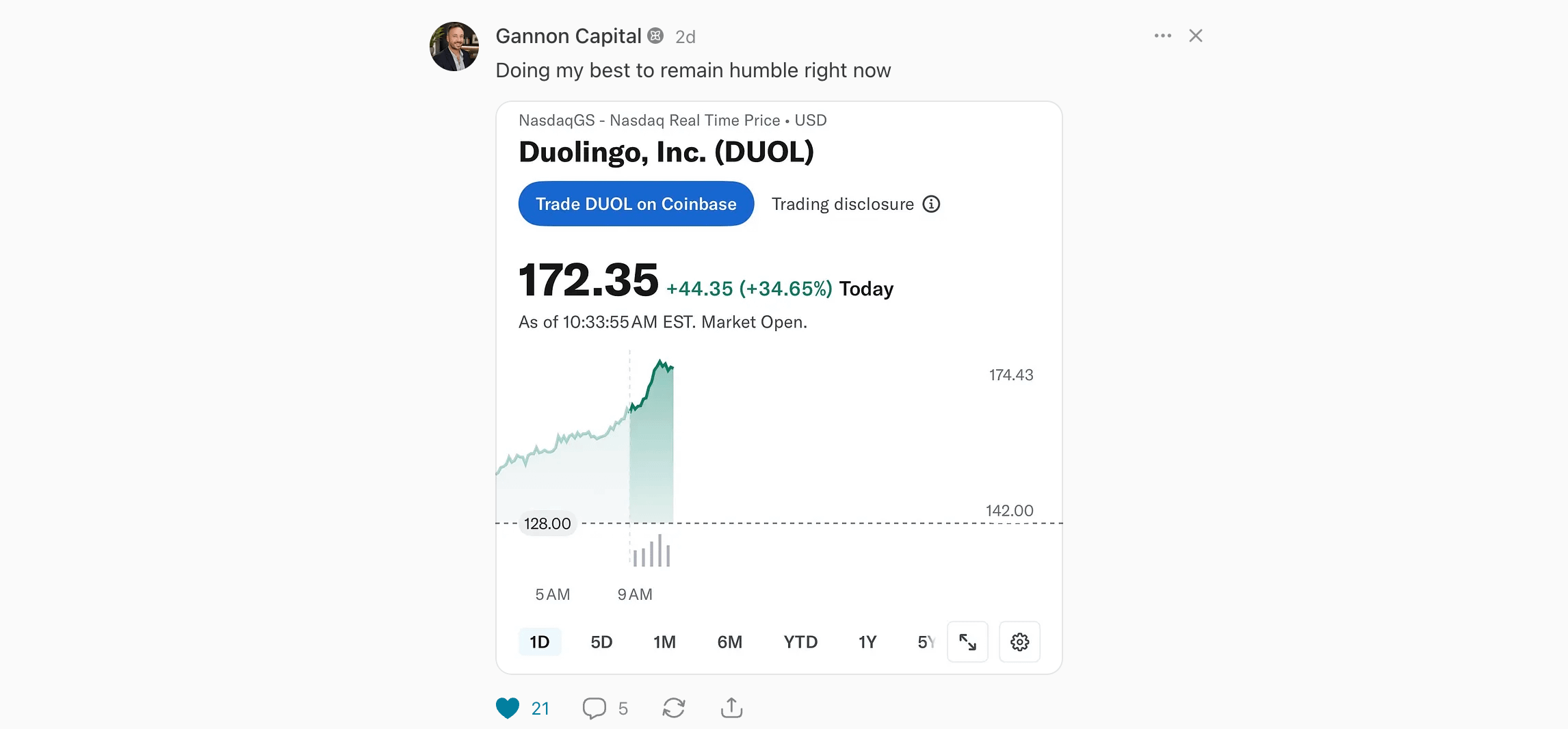
Now investors are suddenly having a much less comfortable conversation about what all that AI infrastructure costs, who will finance it, and how much money it will eventually earn. Meanwhile, Duolingo, a company that has had plenty of questions thrown at it about AI, jumped sharply after its latest results.
Which reminds me; happy to see fellow investor Gannon Capital knock it out of the park recently, after having been holding on to it at much lower levels for a long time:
There are real business questions underneath both stories. What interests me is how quickly the confidence moves from one side of the argument to the other.
Back and forth, back and forth.
On Wednesday, the broad US market rallied after the midterms. On Thursday, the S&P 500 fell about 4% and the Nasdaq fell around 5.5%. Concerns about the outlook for AI spending and data centres were suddenly doing a lot more work in the explanation.
Imagine taking a two-day holiday from the news and trying to catch up with those headlines.
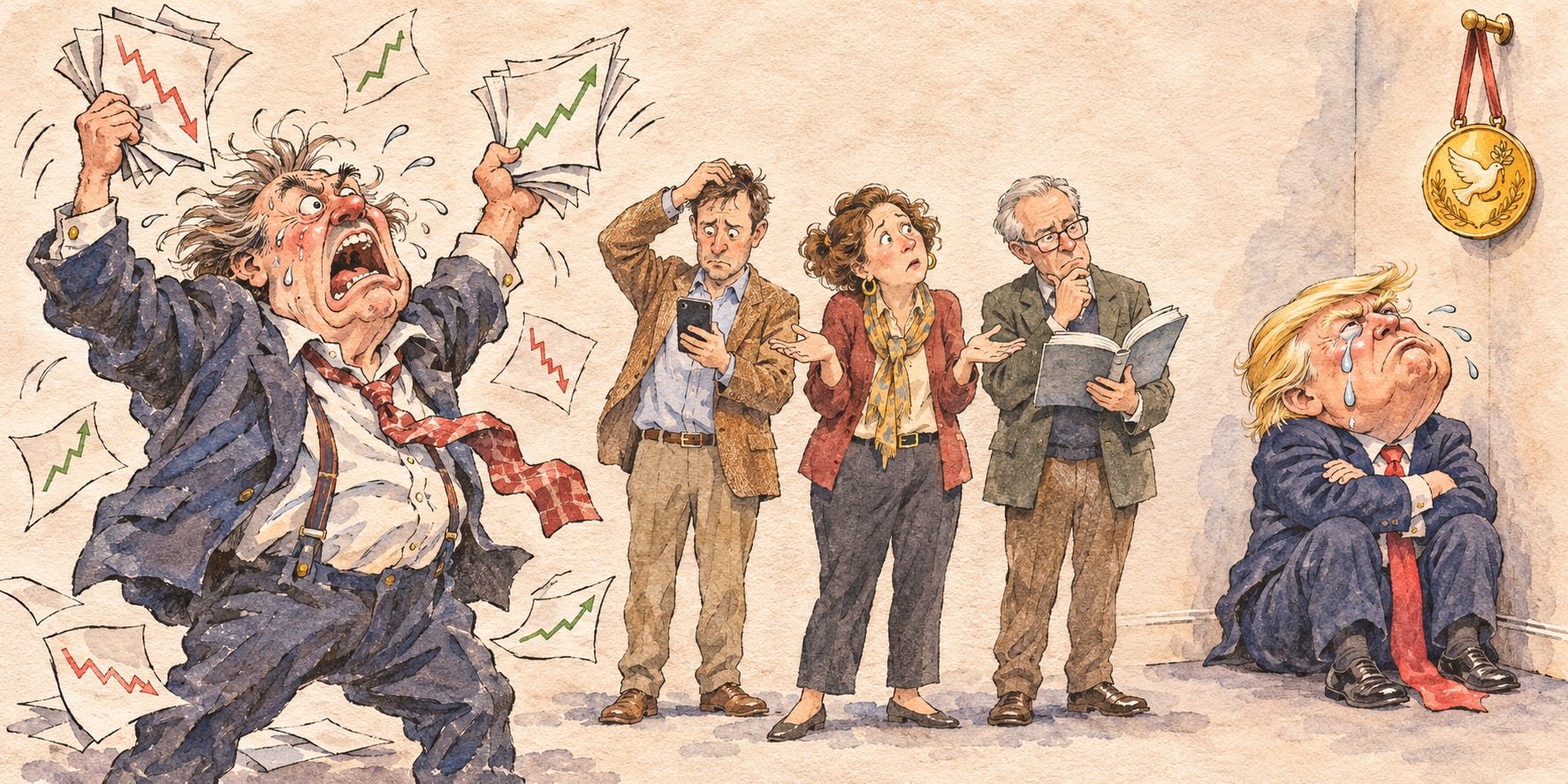
Mr. Market has been throwing a tantrum lately. A bit like a certain American president who can’t get the Nobel Prize he wants.
This is the sort of week that makes me want to revisit Benjamin Graham’s Mr. Market. I also find it a good time to ask how much of my own confidence comes from understanding a business, and how much comes from the color of the number beside it.
A business partner with a price for you
Imagine you own part of a small business. Every morning, your partner offers to buy your share or sell you his.
Some mornings he thinks the business has a glorious future and names a price that assumes everything goes well. Other mornings he’s worried about the economy, the competition and a conversation he had over breakfast. His price reflects that too.
You can accept his offer. You can also get on with your day. He’ll be back tomorrow.
That is Graham’s Mr. Market, as Buffett explained him in his 1987 shareholder letter. The useful part is that you get to choose when to deal with him. But Buffett also makes an important demand of the owner. You need to be capable of understanding and valuing the business yourself.
That last bit deserves more attention than it usually gets.
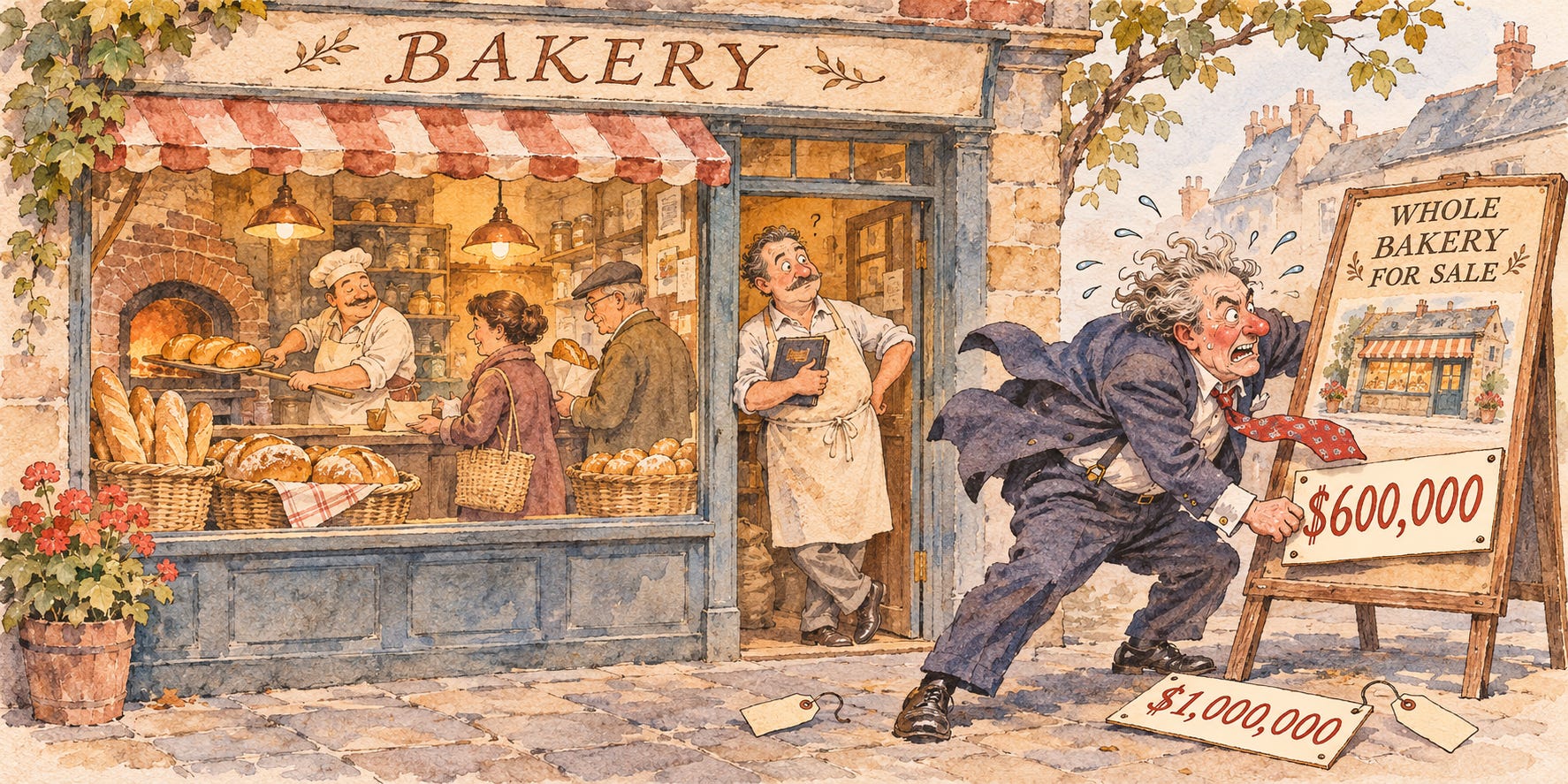
Alright, let’s suppose you own a share of a local bakery. You know roughly what it earns, what the rent costs and whether customers keep coming back. Your partner offering you less for it on Thursday would give you something to think about. You’d probably ask what had happened at the bakery.
With shares, it’s remarkably easy to spend the whole morning studying the offer.
We remember the crash. We forget the feeling.
Looking at an old chart is comfortable. You can actually see where the decline ended. The ugly stretch takes up about an inch of the screen, and you can point to the bottom with a finger.
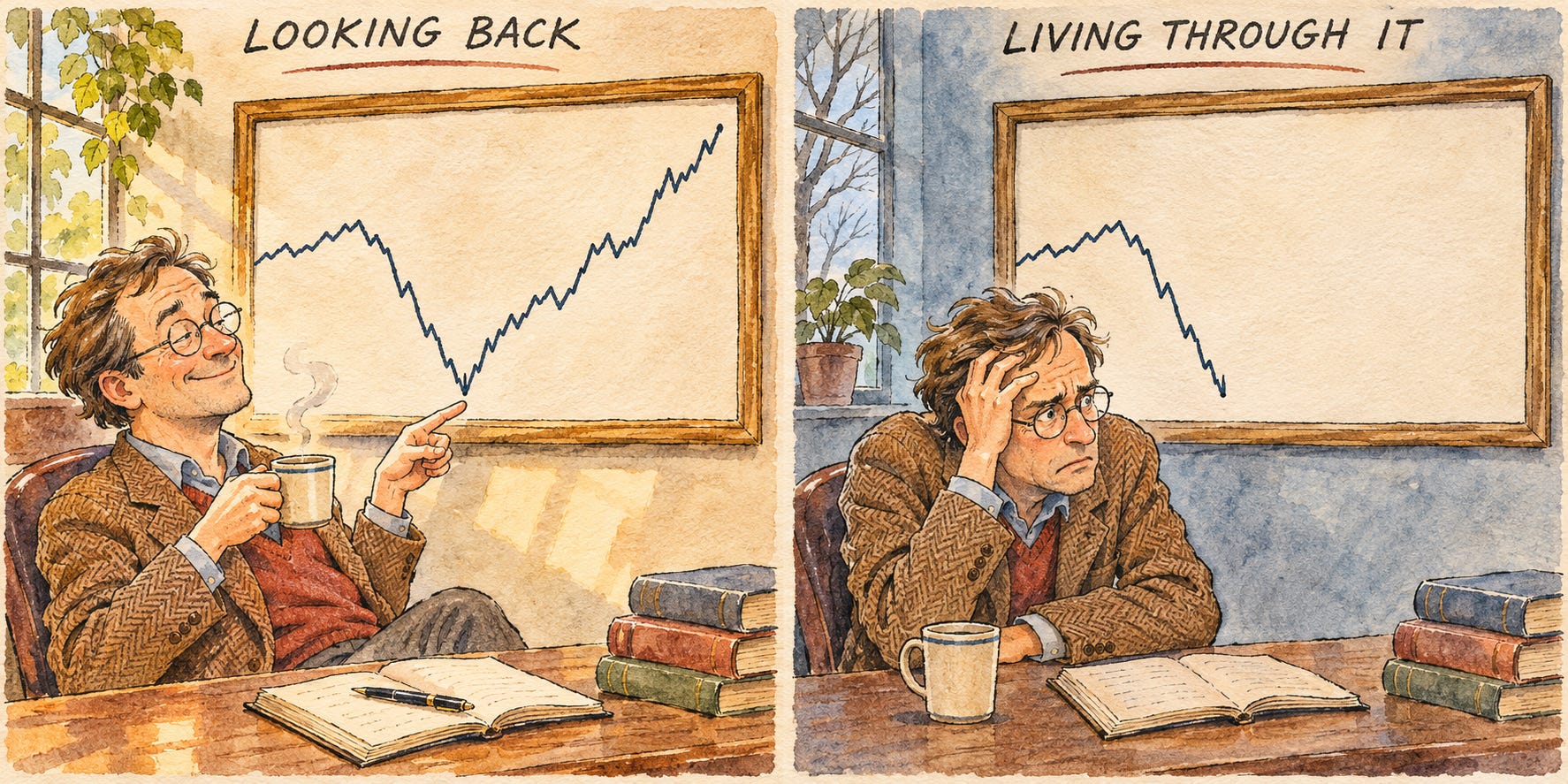
Living through that inch is a whole different experience, as you probably know by now. We don’t get to see the next part of the chart. We get another earnings report, a falling share price and somebody explaining very confidently why your company’s best days are behind it.
It’s easy to say you’d have bought more. You might also have spent the evening wondering whether the person selling knew something you didn’t.
Hindsight is a b**ch.
I think this helps explain why familiar market behavior keeps catching people off guard. Knowing that markets fluctuate gives you very little practice at watching your own money fluctuate. Especially when the people who were enthusiastic a few months ago now sound embarrassed to have liked the investment at all.
And there’s another uncomfortable possibility. Your confidence during the good months may have needed less evidence than you thought.
If a company reports decent results and the shares rise, the decision feels sensible. Give the same report to a falling market and suddenly you find yourself rereading the outlook.
That’s a useful moment to check what you actually expected when you bought.
Sometimes the seller has a deadline
There’s also more going on than people changing their minds.
Leopold Aschenbrenner’s Situational Awareness fund lost 67% in July, according to an investor letter reported by Reuters. Falling positions, leverage and deteriorating liquidity contributed to the trouble, and the fund sold most of its public equity portfolio to Citadel.
The part I find useful to think about is what happened to the freedom to wait.
You can have a detailed view of where an industry will be in ten years. Your lender may still need an answer this afternoon. Once you have to raise cash, the price you accept starts answering a different question.
I’d be careful about reading every sale as a verdict on a company’s future. Sometimes the seller needs the money. Equally, I’d be careful about assuming that an intelligent investor with a persuasive long-term thesis has built a portfolio capable of surviving the journey.
A private investor who can afford to wait has something valuable there. But borrowing, near-term spending needs, or positions that are so large that they keep you awake at night, can brutally take that advantage away.
What would actually make me change my mind?
My preference is to spend time understanding a small number of businesses. I want to know why customers pay them, what would persuade those customers to leave, and what the company has to spend to keep earning their business.
Those questions become particularly useful when Mr. Market gets shaky.
Take a software company. A falling share price would make me revisit the assumptions. Evidence that customers were replacing the product, or that the company had to keep cutting prices to retain them, could change those assumptions considerably.
The same goes for valuation. A company can do well for years and still give its shareholders a disappointing return if they paid too much at the start. A large fall from an expensive price deserves a fresh calculation.
I want the original investment case to be specific enough that I can check it. “Great company” leaves a lot of room for interpretation when you’re trying to defend a losing position.
Who needs its product? Why is it difficult to replace? How much cash can the owners eventually receive after the company has paid for its growth? What did the purchase price require it to achieve?
If those answers still hold up, sitting still can make sense. If the price becomes attractive enough, there may be a reason to commit more money. If something important has broken, the work should help me recognise that too.
Back to my own screen
My portfolio has its share of green and red this year. Some of the boring businesses have given me much less to complain about than the market headlines might suggest. Others have given me plenty of reason to look again.
My portfolio
Paid subscribers can see what I own, follow my portfolio updates and explore my watchlists with my own buy target prices. I explain the reasoning behind my decisions, including what would make me change my mind.
But as always, the market will keep offering opinions. And opportunities. And emotions.
Some of them will turn out to be useful. I’d like to have done enough work that I can decide what to do with the offer without needing everyone else to agree with me first.
If this is how you like to think about investing, you’re welcome to subscribe to The Atomic Moat. I write about businesses, the people who invest in them and what we can learn from both.
What have you checked in your own holdings this week, and did it change your view?
Cheers,
Rob
Mr Market does not exist.