



We need to talk about the Gym Membership.
We have all been there. It is January 2nd. You sign up for a gym that is slightly too expensive and located slightly too far away. By March, you have stopped going. But do you cancel? No.
Why? Because to cancel, you have to drive there between the hours of 10:00 AM and 2:00 PM on a Tuesday, find a manager named “Chad,” sign a physical piece of paper in blood, and listen to a 15-minute pitch about why you’re making a mistake.
So, you keep paying.
Now, imagine that gym membership costs $5 million a year. And imagine that if you do manage to cancel it, your business stops working, your employees can’t get paid, and the federal government sues you.
Welcome to the Switching Cost Moat.
In the world of investing, we love to talk about “Network Effects” (Facebook) or “Low Cost Producers” (Costco). Those are sexy moats. But the Switching Cost moat is different. It isn’t based on love, and it isn’t based on cheap prices. It is based on a fundamental human truth: Laziness and fear.
A high switching cost means that changing to a competitor is so painful, expensive, or risky that a customer will tolerate almost anything (including price hikes) to avoid doing it.
For the Atomic Moat portfolio, I don’t just look for companies that customers love. I look for companies that customers cannot quit.
To analyze this, I have developed the Migraine Index. It rates companies on a scale of 1 to 10 based on how much physical and emotional pain a customer would endure if they tried to switch competitors tomorrow.
Here are 10 companies that have mastered the art of the stick (not ranked, just numbered for easy navigation).

1. Kneat.com
Migraine Index: 9/10
If you run a pharmaceutical company, you don’t just “make drugs.” You generate mountains of paperwork proving that every pipe, vat, and thermometer is clean and working correctly. This is called “validation.”
For decades, this was done on paper. Kneat digitized it.
Why the Switch is Brutal: If a pharma giant like Merck or Pfizer wants to leave Kneat, they aren’t just switching software; they are migrating millions of compliance records.
Here is the kicker: If they lose one record during that migration—just one—and the FDA audits them, they could face millions in fines or be forced to halt production of a life-saving drug. No CTO is going to risk their career to save 5% on a software subscription.
The Vibe: “Nobody gets fired for keeping Kneat. Someone definitely gets fired for losing the compliance data.”
2. Badger Meter
Migraine Index: 8/10
Badger Meter sells water meters and the flow instrumentation technology that utilities use to track usage.
Why the Switch is Brutal: Software is “easy” to delete. Hardware is not. When a city installs Badger’s smart meters, they are physically embedding that company into the ground of every residential driveway and commercial building in the municipality.
If a city wants to switch to a competitor, they have to physically dig up sidewalks, replace thousands of units, and retrain their entire maintenance workforce.
The Vibe: City councils barely have the budget to fix potholes. They absolutely do not have the budget to rip out 50,000 perfectly good water meters just to try a new vendor.
3. Veeva Systems
Migraine Index: 8.5/10
Veeva provides cloud-computing specifically for the life sciences industry. They have two main engines: Commercial (CRM for sales reps) and Vault (managing clinical trials).
Why the Switch is Brutal: While CRMs can be switched (painfully), the “Vault” side of the business is the stickiest substance on earth. This software manages the clinical trial data for new drugs. It dictates the workflow of scientists, regulatory affairs officers, and clinical ops teams.
Veeva has effectively become the operating system for modern drug development. To switch away from Veeva is to un-train thousands of scientists on how to do their daily jobs.
The Vibe: Trying to get a salesperson to learn a new tool is annoying. Trying to get a scientist to learn a new clinical trial system while in Phase III testing is impossible.
4. Intuitive Surgical
Migraine Index: 9.5/10
Intuitive makes the Da Vinci surgical robot. They are the clear dominant player in robotic-assisted surgery.
Why the Switch is Brutal: This is perhaps the only moat based on human physiology. Surgeons spend hundreds of hours training on the Da Vinci system. The controls become an extension of their hands. They develop deep muscle memory for exactly how the machine responds to a twitch of the wrist.
Asking a surgeon to switch to a competitor’s robot is like asking a concert violinist to suddenly play the cello in front of a live audience. The hospital buys what the surgeon wants, and the surgeon wants the robot they know how to drive.
5. Jack Henry & Associates
Migraine Index: 10/10 (The King of Pain)
Jack Henry provides “core processing” systems for small to mid-sized banks. The “core” is the ledger that tracks who has what money.
Why the Switch is Brutal: In banking IT, switching a core processor is literally referred to as “open-heart surgery.” It takes 18 to 24 months. It costs millions. And if it goes wrong (which it often does), customers can’t access their money, debit cards stop working, and the bank faces a run on deposits.
Bank CEOs will endure terrible customer service and high prices from their core provider because the alternative is a project that could end the bank’s existence.
6. Autodesk
Migraine Index: 8.5/10
Autodesk owns the standard toolkits for the physical world: AutoCAD (2D) and Revit (3D BIM) for architects and engineers.
Why the Switch is Brutal: This is a double-lock. First, there is File Format Capture. Architectural projects last for years. If a firm switches software, they lose the ability to easily edit their last 20 years of blueprints because the file formats are proprietary.
Second, there is Intellectual Lock-in. Revit is not just a drawing tool; it is a complex database of a building. Engineers spend years mastering the specific keystrokes and workflows. If a firm switches to a competitor, productivity drops to near zero for six months while expensive staff relearn how to design a building.
The Vibe: “The most expensive thing in the world is a bored engineer. The second most expensive thing is an engineer learning new software.”
7. ADP / Paychex
Migraine Index: 7.5/10
These duopolies handle payroll and Human Capital Management (HCM). They are the plumbing of the labor market.
Why the Switch is Brutal: Payroll is an asymmetric risk. There is no upside to getting it right (people just expect to get paid), but there is catastrophic downside to getting it wrong.
Switching payroll providers introduces the risk of “The Miss.” If a migration error causes 500 employees to miss a paycheck, or if tax withholdings are calculated incorrectly, the company faces an immediate morale crisis and potential lawsuits. CFOs are terrified of this. They would rather overpay ADP forever than risk a single pay period of chaos.
The Vibe: “The CEO will switch email providers, coffee vendors, and office locations before they risk messing up the direct deposit file.”
8. Constellation Software
Migraine Index: 9/10
Constellation is a holding company that buys Vertical Market Software (VMS). These are tiny software companies that run specific niches: software for managing public transit, software for running a marina, or software for bowling alleys.
Why the Switch is Brutal: In these micro-verticals, Constellation often owns the only viable modern software. They are effectively unregulated monopolies in tiny ponds.
If you run a country club and Constellation owns the software that manages your tee times, restaurant billing, and membership dues, you cannot leave. There isn’t a “competitor down the street.” The alternative is often a pen and paper. Constellation knows this, which is why they can raise prices consistently without losing customers.
The Vibe: “Where are you going to go? We own the market. Price increase accepted.”
9. Cintas
Migraine Index: 7/10
Cintas provides uniform rentals, facility services, and entrance mats. They are not a tech company, but their moat is incredibly wide.
Why the Switch is Brutal: This is a moat built on hassle. Cintas services are deeply embedded in the physical operations of a business. Their trucks show up every week on a specific route.
To switch competitors, a factory manager has to coordinate a “Uniform Return Day.” They have to collect 500 dirty shirts from 100 grumpy mechanics, audit them for damage, pay for any missing items, and then coordinate a measuring day with the new company. It is a massive operational disruption for a very small cost saving. Most managers simply renew the contract to avoid the headache.
The Vibe: “Is it worth saving $50 a week to coordinate a massive logistical headache with 100 employees? No.”
10. CoStar Group
Migraine Index: 8/10
CoStar is the dominant provider of information, analytics, and marketing for commercial real estate.
Why the Switch is Brutal: CoStar has spent 30 years building a database that no one else can match. They have thousands of researchers calling landlords every day to track rent rolls and vacancies.
If a commercial broker cancels CoStar to save money, they are effectively blinding themselves. They cannot see inventory, they cannot see “comps” (comparable sales), and they cannot market their listings to the widest audience. In an information business, cutting off your information supply is suicide.
The Vibe: “It’s the Bloomberg Terminal of real estate. You can complain about the price, but you can’t do your job without it.”
The Alpha: Why “Pain” = “Pricing Power”
Why do we care about this as investors? Because a Switching Cost moat is the primary driver of Pricing Power.
Inflation is the enemy of investment returns. If a company’s costs go up (wages, servers, electricity), they must raise prices to maintain their margins.
Company A (No Moat): Raises prices by 10%. Customers leave for a cheaper competitor. Revenue drops.
Company B (Switching Cost Moat): Raises prices by 10%. Customers grumble, curse, and... pay the invoice.
This creates a beautiful mathematical compounding effect. If a software company has a 0% churn rate (because nobody can leave) and raises prices 5% annually, all of that increase flows almost directly to the bottom line.
Let’s look at the math of “Pricing Power” relative to Margins.
The formula for the impact on profit is simple: Change in Profit = Price Increase divided by Profit Margin.
If a company has a 20% profit margin and they raise prices by 5% without losing customers, their profit doesn’t just grow by 5%.
It grows by 25%.
(The Math: 5% Price Hike / 20% Margin = 25% Increase in Net Income).
This is the “Atomic” power of the moat. Small price hikes, accepted by “hostage” customers, result in massive compounding of free cash flow over a decade.
The Counter-Point: The Danger of the “Abusive Landlord”
However, and this is critical, we must not be reckless.
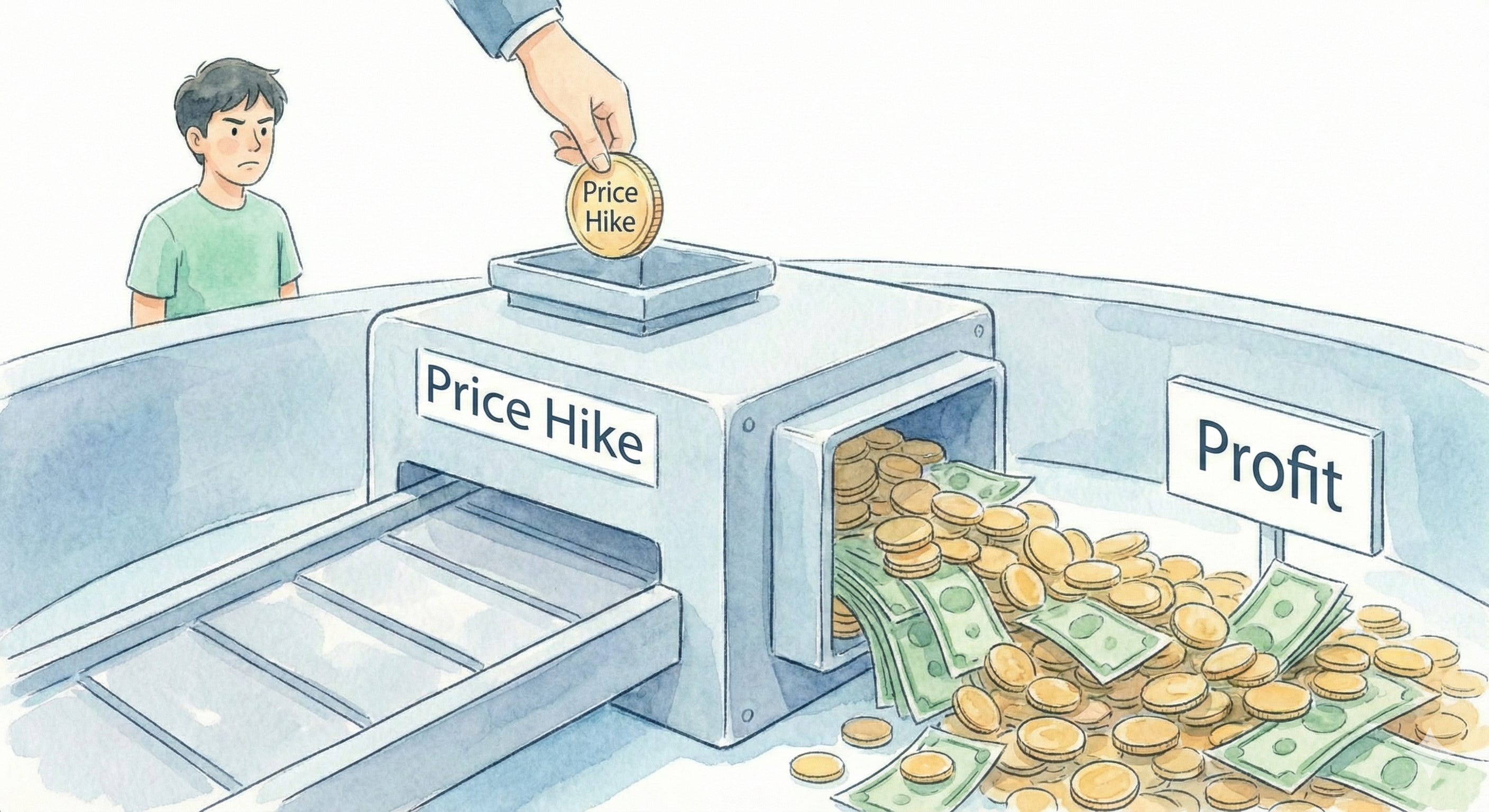
Just because a company has a switching cost moat does not mean it is a guaranteed winner. In fact, this specific moat breeds a specific type of management laziness that can destroy shareholder value.
1. The “Revolt” Threshold
There is a limit to how much you can abuse your customers. A perfect recent example is the Unity Software scandal. Unity is a game engine with high switching costs (developers spend years building games on it).
Feeling invincible, Unity announced a retroactive “runtime fee” that would have bankrupted many indie developers. They assumed developers were stuck. They were wrong. The backlash was so severe—a total revolt—that the CEO was ousted and the stock cratered. If you treat your customers like hostages, eventually they will burn the building down.
2. The “Innovation Rot”
Companies with high switching costs often stop innovating. Why improve the product if the customer can’t leave? (See: Traditional Banking). Eventually, the technology gap becomes so wide that a disruptor comes along and makes the “pain of switching” worth it. Switching costs are a wall, but they are not impenetrable. If the product rots, the customers will eventually climb the wall.
3. Valuation Matters
Finally, the market knows these companies are great. Kneat, CoStar, and Veeva rarely trade at “cheap” multiples. Buying a high-switching-cost business at 100x earnings removes your safety margin. The moat protects the business, but the valuation protects the investor. You need both.
So…
When you are looking for your next investment, ask yourself the “Migraine Question.”
Don’t just ask if the product is good. Ask: “If I were a customer, how much Advil would I need to take to switch away from this company?”
If the answer is “a whole bottle,” you might have found an… Atomic Moat.
Which companies are you stuck with in your professional life? Which software or service do you hate but can’t quit? Let me know in the comments below; I’m always looking for new ideas.
Disclaimer: This article is for informational and educational purposes only and does not constitute financial advice, investment recommendations, or an offer to buy or sell any securities. I am not a financial advisor. The views expressed are my own and based on my own research. I may hold long or short positions in the companies discussed. Please do your own due diligence and consult a qualified financial professional before making any investment decisions.