



“This is really the bottom line: not whether you dare to be different or to be wrong, but whether you dare to look wrong.”
—Howard Marks
It is easy to be a contrarian when the graph is green. It is agonizing when the graph is red. To beat the market, you must deviate from the market—and for long stretches of time, that indistinguishable from being an idiot.
Today, I am voluntarily stepping into that line of fire.
Publishing a real-money portfolio “naked” on the internet is scary. There is no place to hide. If my thesis on these companies is flawed, I won’t just lose money; I will lose it in public. I will look wrong. I might even look stupid.
But in the Bunker, I believe that transparency is the ultimate discipline. Skin in the game, honesty and integrity matters more than reputation.
So, with the risk of looking wrong firmly accepted, here is how we are positioned for the future.
GEOGRAPHIC DEPLOYMENT
I hunt for the best deals all over the globe. This is my current diversification:
🌎 Latin America: ~27% of portfolio
🇨🇦 North America: ~23% of portfolio
🌍 Global/Digital: ~18% of portfolio
🇪🇺 Europe/Nordics: ~17% of portfolio
🌏 Southeast Asia: ~15% of portfolio
SILENCE IN THE WASTELAND
Charlie Munger used to say, “The big money is not in the buying and the selling, but in the waiting.”
Out there in “The Wasteland” (Wall Street), they don’t know how to wait. They run around trying to predict what the Federal Reserve will do next Tuesday, or whether an AI chip company beat earnings by a penny. It’s noisy. It’s frantic. It’s a great way to go broke slowly.
Here in “The Bunker,” I do things differently. I don’t rent stocks; I own businesses. I don’t build a portfolio to look like the S&P 500.
I use a strategy I call “The Atomic Barbell.” On one side, I have the heavyweights—the “Nomad Core”—modeled after the philosophy of Nick Sleep. These are my “Destination” assets. On the other side, I have the “Venture Bucket,” modeled after Peter Lynch. These are the ‘scrappy’ fighters. Misunderstood, under analyzed, boring, undervalued, and ready to punch above their weight.
Here is exactly what I own, why I own it, and where I think we’re going.
PART I: THE “NOMAD CORE” (The Compounders)
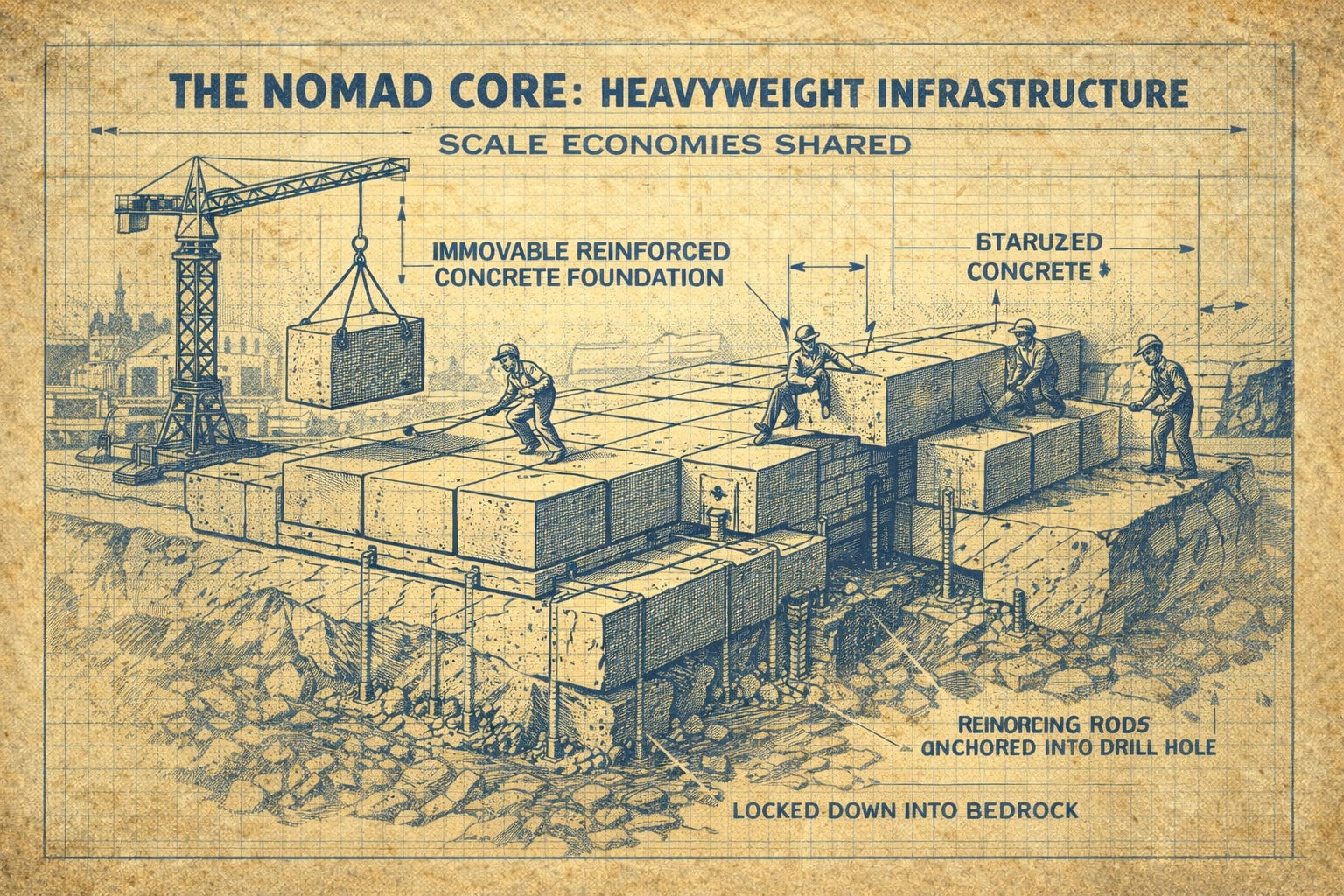
Allocation: ~73% | Philosophy: Destination Analysis & Scale Economies Shared
The largest part of the portfolio is inspired by Nick Sleep, Qais Zakaria and their Nomad Partnership. These are the businesses I plan to hold for a very long time, unless something bad happens fundamentally. I don’t ask “what will they earn next quarter?” Instead I ask, “will they be the default infrastructure of their continent in ten years?”
1. MercadoLibre (MELI) – The Emperor
Weight: 26.9%
The Role: The “Amazon + PayPal” of Latin America.
The Plain English Case: Think of MELI as the operating system for an entire continent. They did the impossible: they built a delivery network (Mercado Envios) that conquered the Amazon rainforest and the chaotic streets of São Paulo. That’s the physical moat. But here’s the kicker: they used that commerce flow to build a bank (Mercado Pago) for people the traditional banks ignored. It’s a dual-monopoly. The more people buy, the more they bank. The more they bank, the more they buy. I am heavy here because frankly, there is no second place in this race.
You can read my thesis on MercadoLibre here.
2. Sea Ltd (SE) – The Digital Conglomerate
Weight: 15.2%
The Role: The “Tencent of Southeast Asia.”
The Plain English Case: Sea Ltd is a master of the “Internal Capital Market.” They own a cash-printing machine called Free Fire (a global gaming monopoly). Instead of letting that cash sit there, they shovel it into building Shopee (e-commerce) and SeaMoney (fintech). While their competitors are begging venture capitalists for funding, Sea Ltd funds its own war chest. They are building the digital and physical rails of Southeast Asia with their own money.
You can read my thesis on Sea Ltd here.
3. Fairfax Financial (FFH) – The Fortress
Weight: 11.5%
The Role: The “Canadian Berkshire.”
The Plain English Case: Prem Watsa runs a “Float Machine.” He takes insurance premiums (other people’s money) and invests them in undervalued assets. For every $1 of equity, Fairfax controls about $4 of investment assets. Right now, we are in a “hard market” (insurance premiums are high) and interest rates are up. That means the float is earning record returns. This is my defensive hedge against tech volatility. A boring, cash-generating fortress.
You can read my thesis on Fairfax here.
4. InPost (INPST) – The Utility
Weight: 9.8%
The Role: The “Last Mile” of Europe.
The Plain English Case: Door-to-door delivery is inefficient. It’s expensive and slow. InPost replaces the delivery van with the Automated Parcel Machine (APM). It’s a simple math problem: One driver can drop 1,000 parcels at a locker wall in the time it takes to drop 100 at people’s homes. This creates a “win-win-win”: Merchants pay less, customers get their stuff faster, and InPost takes a cut of the efficiency. It is becoming the utility of European e-commerce.
You can read my thesis on InPost here.
5. Duolingo (DUOL) – The Habit Monopoly
Weight: 9.6%
The Role: “Sesame Street 2.0.”
The Plain English Case: Duolingo isn’t just an app; it’s a data vampire. By offering the product for free, they aggregate billions of user interactions. This data trains “BirdBrain,” their AI, to be smarter than any human tutor. They don’t compete with textbooks; they compete with TikTok. They have weaponized “habit” and “attention” to build a moat that money can’t buy.
So, the heavyweights are secured. These are the castles we will live in for the next decade.
Right now, looking at current prices, I will probably be adding capital to Duolingo and/or Fairfax on potential dips.
But a complete Atomic Portfolio needs aggressive growth. We need the fighters. The stocks that can double or triple because Wall Street has completely misunderstood them, or don’t know they even exist.
Below, we open the blast doors to The Venture Bucket. These are the 6 ‘unlovable’ stocks we are betting on for asymmetric upside—including the ‘Turnaround Captain’ and the ‘Hidden Gem’ of the cannabis sector.
Upgrade to High Command to see the full list and exact allocations.
PART II: THE VENTURE BUCKET (The 10-bagger Lynch Playbook)
Allocation: ~27% | Philosophy: Asymmetric Upside (Turnarounds & Fast Growers)
This is where we get our hands dirty. We look for the “unlovable” stocks—the ones the market hates, ignores, or misunderstands.
6. Root Inc. (ROOT) – The Turnaround
Weight: 8.7%
The Lynch Logic: Wall Street left this company for dead. They priced it for bankruptcy. But look at the numbers: Root fixed its underwriting, stopped the bleeding, and is now generating over $200M in cash flow. This is the “Captain” of my venture bucket because the turnaround isn’t a hope—it’s a mathematical fact.
7. IREN – The Asset Play
Weight: 4.7%
The Lynch Logic: This is a play on “Digital Real Estate”. With IREN, I am not just betting on Bitcoin price action. I own the power plants, the cooling systems, and the data centers required for the two biggest energy hogs in history: Bitcoin mining and AI. It’s a pick-and-shovel play on the digital age.
8. Devyser Diagnostics (DVYSR) – The Fast Grower
Weight: 4.1%
The Lynch Logic: A classic “Razor & Blade” model. They sell testing kits (blades) to labs that already own the machines. It’s recurring revenue in a niche medical market. They are right at the tipping point of profitability—that sweet spot where the risk premium vanishes and the stock re-rates.
You can read my thesis on Devyser here.
9. Nodebis Applications (NODE) – The Stalwart
Weight: 3.4%
The Lynch Logic: Think of this as “The Little Vitec.” It’s a boring Swedish holding company that buys small software firms and lets them grow. It provides stability to the venture bucket. It’s not flashy, but it compounds.
You can read my thesis on Nodebis here.
10. Cannara Biotech (LOVE) – The Hidden Gem
Weight: 3.0%
The Lynch Logic: The “Last Man Standing” in the hated cannabis sector. While everyone else went bankrupt chasing hype, Cannara stayed profitable. They have 20% margins and 30% growth, yet they trade at ~8x cash flow because investors are allergic to the sector. I love buying what others are allergic to.
THE VERDICT: STAYING RATIONAL

On Valuation: I have grown allergic to paying “hopes and dreams” prices. Even my high-growth tech stocks (MELI, SE) are printing cash. In the Venture Bucket, I am buying dollar bills for 50 cents because they are slightly crumpled. I demand a “Margin of Safety”—either in the form of a structural moat (Nomad Core) or a depressed price (Venture Bucket).
On Risks: The biggest risk isn’t volatility. I don’t care if the portfolio drops 20% next month. The biggest risk is permanent impairment—buying a business that disappears. That is why I obsess over the “Moat.” A strong moat protects the castle even when the weather gets bad.
The Final Word: This portfolio is an Anti-Index. It looks nothing like the S&P 500. It will behave differently. Some days I will look like a genius; some days I will look like an absolute moron. But if my “Destination Analysis” is right, I am holding the infrastructure of the future economy.
Sit on your hands. Let the compounding happen.
Stay rational.
THE ATOMIC ROSTER (SUMMARY):
| TICKER | ROLE             | WEIGHT | THEME                  |
|:-------|:-----------------|:-------|:-----------------------|
| MELI   | The Emperor      | 26.9%  | LatAm Logistics/Fintech|
| SE     | Conglomerate     | 15.2%  | SE-Asia Gaming/E-comm  |
| FFH    | The Fortress     | 11.5%  | Insurance Float        |
| INPST  | The Utility      |  9.8%  | EU E-commerce Infra    |
| DUOL   | Habit Monopoly   |  9.6%  | Global Ed-Tech         |
| ROOT   | Venture Captain  |  8.7%  | AI Insurance Turnaround|
| INOD   | AI  |  6.7%  | AI Insurance Turnaround|
| IREN   | Asset Play       |  4.7%  | Digital Infrastructure |
| DVYSR  | Fast Grower      |  4.1%  | Niche MedTech          |
| NODE | The Stalwart | 3.4% | Nordic Software Serial |DISCLAIMER & DISCLOSURE
The Atomic Moat is a financial publisher, not an investment advisor. All content is for informational and entertainment purposes only and does not constitute financial advice. The author (Rob H.) is not a licensed financial professional. Investing involves a high degree of risk, including the potential loss of your entire investment. The author holds long positions in all securities discussed. Do your own due diligence before deploying capital.