


There’s a small scene in HBO’s The Gilded Age that has stayed with me. Only a few seconds long: A young boy is standing on a street, climbing a ladder to light a gas lamp. It’s the kind of background detail you barely notice while New York’s wealthiest families are busy fighting over social status, opera houses and dinner invitations.
I found myself thinking about that scene long after the episode ended. Imagine. Once, lighting street lamps was once a perfectly ordinary job. Someone had to do it every evening, and someone had to extinguish them again in the morning.
And then… ZAP! Electricity arrived.
The transition did not happen overnight, but eventually there was no longer much need for people to walk around lighting street lamps.

Imagine being that boy. You’re simply doing your job, earning a living, going about your day as you always have. Meanwhile, somewhere else in the city, people are developing a technology that will eventually make your job obsolete.
And here we are, some 140 years later, watching another technological revolution unfold.
AI is changing how people work. Robotics is advancing. Populations are aging, electricity demand is rising, and companies are spending billions preparing for a very different future.
I have no idea what the world will look like in 2066. But I suspect many of today’s jobs and businesses will have changed beyond recognition.
Which got me thinking about the investing perspective of it all.
If I had stood on Wall Street in 1890 with a modest amount of money, where should I have invested it? Which businesses would have made me wealthy? And which seemingly obvious opportunities would have left me with nothing?
We know which industries changed the world back then. But which ones actually made investors wealthy?
And can we use what happened to build a robust portfolio that outperforms the market for the next twenty or forty years?
That’s what I want to explore in this piece.
First, we’ll look at the historical winners and losers. Then I’ll share what I think we can learn from them. Finally, I’ll put those lessons to work by building an example portfolio of companies that could benefit from AI, robotics, electrification, demographic changes and other developments.
With one important condition: Every company must make sense as an investment, including the price we pay for it.
Let’s see what history has to say.
1. Then and Now

The railroad lesson
In the late nineteenth century, America was changing at an extraordinary pace.
Railroads connected cities and opened new markets. Electricity began replacing gas lighting. The telephone made long-distance communication possible, while new machinery transformed factories and agriculture.
Investors had plenty of reasons to be excited.
Take railroads for example. In 1900, railroad companies represented approximately 63% of the US stock market. They were essential to the economy, and there was every reason to believe they would remain important for decades.
Yet many railroad companies were terrible investments.
Building tracks, bridges and locomotives required enormous amounts of capital. Competition was fierce, debt levels were often excessive, and bankruptcies were common.
Union Pacific, for example, entered receivership in 1893. The railroad itself was an enormous technological success. That offered little comfort to shareholders who suffered through its financial collapse.
But Union Pacific example aside: research by Elroy Dimson, Paul Marsh and Mike Staunton shows that US railroad stocks actually outperformed the broader American stock market between 1900 and 2014.
How?
The industry eventually consolidated, became more efficient and benefited from deregulation. The surviving companies developed stronger economics, and investors who bought them at attractive prices could earn excellent returns.
An industry could transform the economy, destroy fortunes along the way, and eventually become an excellent investment again.
Now think about what’s happening with AI.
Companies are spending enormous sums on data centers, chips and computing infrastructure. The technology will probably be incredibly important, just as railroads were.
But will all those investments earn attractive returns?
Well, honestly, I have my doubts.
Some companies will make fortunes. Others may struggle to recover what they’ve invested. And some of the biggest beneficiaries could be businesses that use the technology without having to finance its development.
And that’s the first lesson I’d take from the Gilded Age: The success of a technology tells us little about the returns investors will earn from it.
The unexpected winners
Now for something I found even more surprising:
Dimson, Marsh and Staunton studied the performance of American industries over 115 years, from 1900 to 2014. The best-performing industry wasn’t railroads, electricity or machinery.
It was tobacco.
US tobacco stocks delivered an annualized total return of approximately 14.6%, compared with 9.6% for the broader American market.
One dollar invested in tobacco stocks in 1900, with dividends reinvested, would have grown to more than $6 million by the end of 2014.
The same dollar invested in the overall American market would have grown to about $38,000.
Those are some smokin’ hot returns!
The research only includes industries with continuous historical records, so we need to be careful about hindsight bias. Still, the difference is remarkable.
Tobacco is obviously a troubling product from a public-health perspective. Its investment history, however, tells us something about business economics.
Many tobacco companies had powerful brands, loyal customers, substantial pricing power and the ability to return large amounts of cash to shareholders. Regulatory concerns also meant investors sometimes valued them quite cheaply.
And tobacco wasn’t alone.
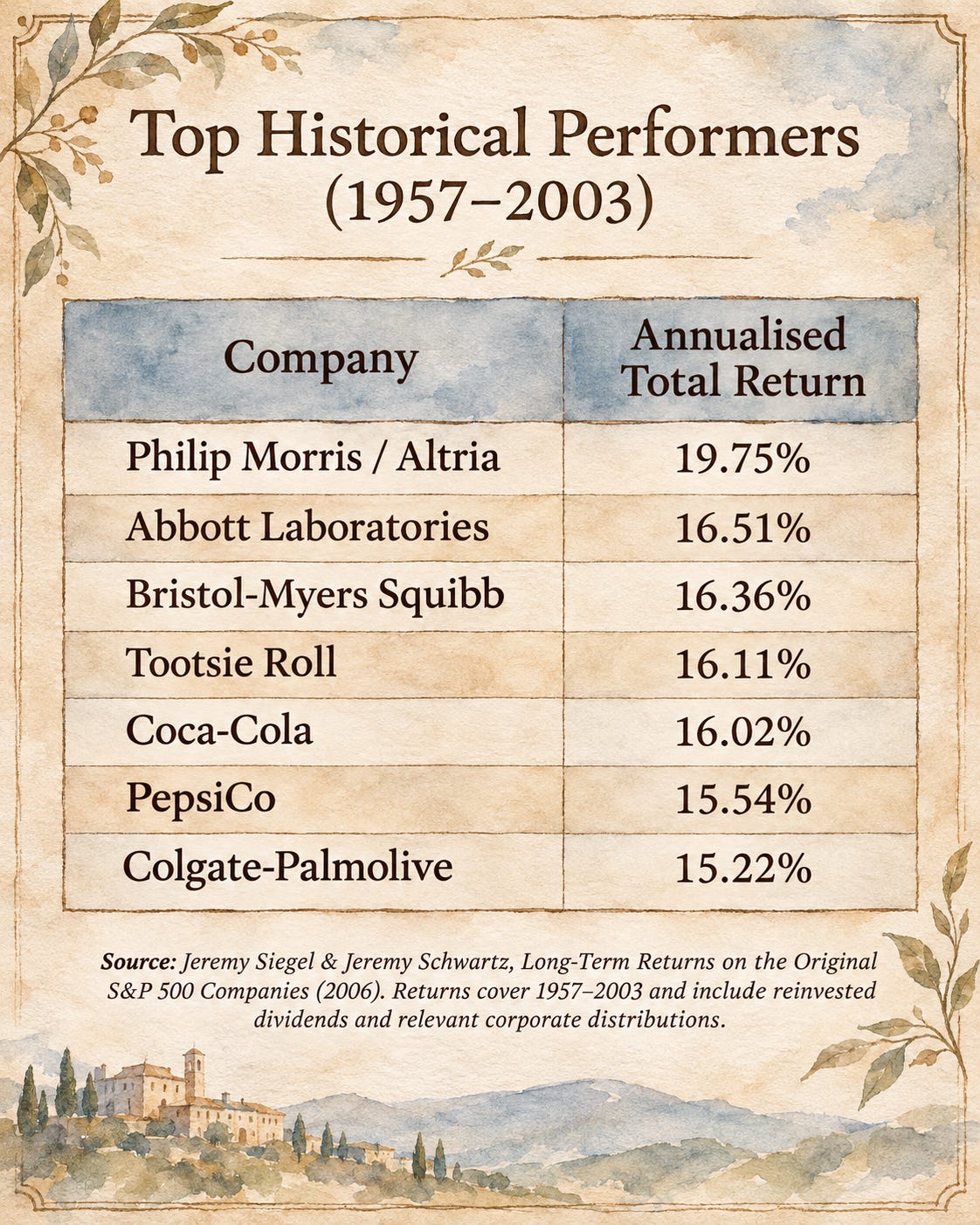
Jeremy Siegel and Jeremy Schwartz studied the original S&P 500 companies between 1957 and 2003. Among the best-performing surviving companies were Philip Morris, Abbott Laboratories, Bristol-Myers Squibb, Tootsie Roll, Coca-Cola, PepsiCo and Colgate-Palmolive.
Philip Morris delivered approximately 19.75% annually. Coca-Cola returned 16.02%, while Colgate-Palmolive managed 15.22%.
Think about everything that happened during those years:
Computers became mainstream.
Humans landed on the moon.
Semiconductors transformed industry.
The internet arrived.
Yet some of the best-performing companies were selling cigarettes, soft drinks, chocolate, toothpaste and pharmaceuticals.
Coca-Cola didn’t need to invent the personal computer. Colgate didn’t need to become an internet company.
Nope. They had strong businesses with products people kept buying.
As populations grew, distribution improved and new markets opened, these companies found more opportunities to sell their products. Many could raise prices, improve productivity and distribute substantial amounts of cash to shareholders.
Some businesses were so well positioned that they could keep doing this for decades.
But of course, there were losers too.
Kodak once dominated photography. Bethlehem Steel was an industrial giant. Both eventually lost much of what had made them successful.
A great company today can become a terrible business tomorrow. And the historical data show just how difficult it can be to find the winners.
Just how rare are the great investments?
In 2026, Hendrik Bessembinder published an updated study covering nearly 30,000 American stocks from 1926 to 2025.
His findings: Almost 60% of companies reduced shareholder wealth relative to an investment in short-term US Treasury bills over their time in the market.
Meanwhile, just 46 companies accounted for half of the approximately $91 trillion in net shareholder wealth created over the entire century.
Apple, Nvidia, Microsoft, Alphabet and Amazon were among the largest contributors, so technology has certainly created extraordinary wealth.
But some of the highest cumulative returns over very long periods came from companies such as Coca-Cola, Eaton, Deere, IBM and S&P Global.
Very different businesses, operating in very different industries.
Yet several managed to remain profitable and relevant through generations of technological change.
I find this kind of research fascinating. Looking at what actually made investors wealthy, and trying to figure out what we can learn from it today.
If you’re into that sort of thing too, I think you’ll enjoy Atomic Moat. I write about businesses, investing and the occasional lesson from history.
Subscribe for FREE and join me and the other Moaters!
2. My reflections
The historical winners had several characteristics in common. Many sold products or services that customers needed repeatedly. They had strong brands, valuable distribution networks, specialised technology or other advantages that made competition difficult.

They generated cash, reinvested it profitably and found ways to keep growing.
A business that earns attractive returns for five years can be a good investment. A business that manages to do it for forty years can create extraordinary wealth.
But here’s where things get interesting when we look at today’s world. Imagine an established company with millions of customers, strong pricing power and substantial recurring revenue.
Now imagine AI allows that company to reduce its operating costs significantly. What happens to its profits?
Potentially, they increase dramatically. But what if every competitor can do the same thing? Then, prices may fall. Customers benefit. The providers of AI technology may capture some of the value.
The company’s productivity improves, yet shareholders may see surprisingly little of the gain.
So the question I’m most interested in is this:
Which businesses will actually get to keep the economic benefits of the coming technological changes?
I think this is where the historical lessons become useful.
A company with strong customer relationships, network effects, pricing power or significant switching costs may be better positioned to retain those benefits.
And the changes ahead go far beyond just AI:
Robotics may transform manufacturing and healthcare.
Aging populations will change demand for goods and services.
Electrification requires enormous amounts of infrastructure.
Digital payments are expanding, and global trade continues to evolve.
These developments will affect different businesses in different ways.
I don’t think we need to predict exactly how every technology develops to benefit from these changes. I’d much rather identify companies that already have strong businesses and stand to become even more valuable as the world develops.
That brings me to the investing philosophy of Warren Buffett, Charlie Munger and Nick Sleep, and the principles I want to follow at Atomic Moat.
Look for businesses with durable competitive advantages, attractive returns on capital and opportunities to reinvest their earnings over long periods.
But there’s another lesson from history we shouldn’t forget.
A wonderful company isn’t necessarily a wonderful investment.
The price you pay matters.
Imagine buying a company at 40 times earnings. It grows earnings per share by 15% annually for ten years. That’s excellent growth.
But if investors are only willing to pay 20 times earnings at the end of that period, your annualised share price return would be approximately 7.3%, excluding dividends. The business performed beautifully, but the investment itself was considerably less spectacular.
Now imagine paying that same high valuation for a company whose growth eventually disappoints.
It’s easy to understand how investors can lose money even when they’re right about an industry’s future.
Which leads me to the practical part of this exercise:
What would a portfolio built around these lessons actually look like?
3. Building a Portfolio for the Next Twenty Years

I want to try something:
Let’s imagine we’re building a stock portfolio in November 2026 with the intention of owning businesses for the next ten, twenty or even forty years.
We’re not trying to predict exactly which technology will dominate the future. We want exposure to several important developments while owning companies with economic characteristics that have served shareholders well historically.
The criteria are fairly straightforward.
I want businesses with established competitive advantages, good returns on capital, strong cash generation and room to grow.
I also want different sources of growth. A portfolio dependent entirely on AI spending would leave us vulnerable to the same problem railroad investors faced more than a century ago.
And every investment needs to make sense at the price paid.
For now, I’m going to put valuation aside and focus on business quality and long-term positioning. We’ll return to valuation before making any actual investment decision.
Here is the example portfolio I’d start researching:
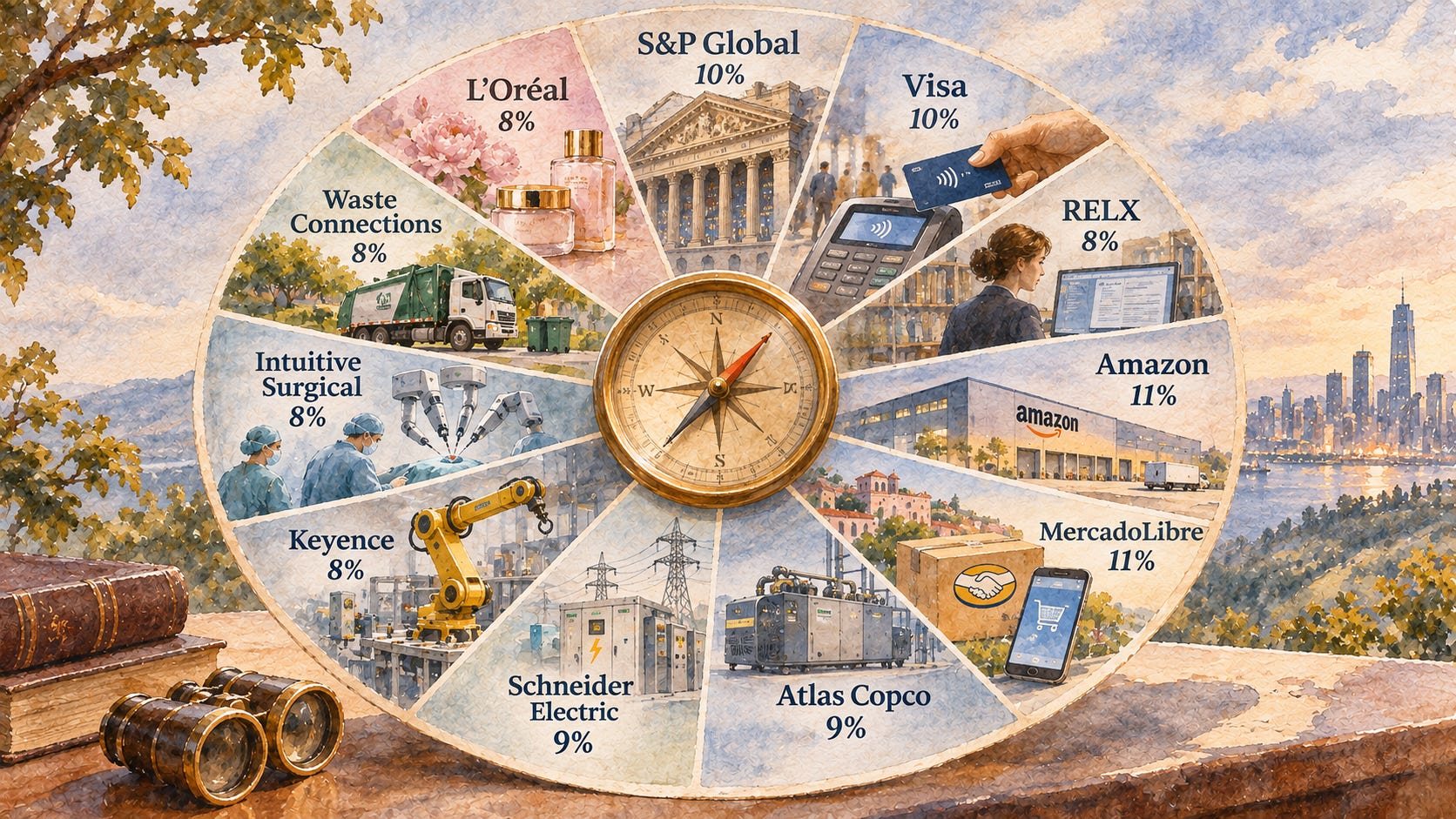
The Lamplighter Portfolio
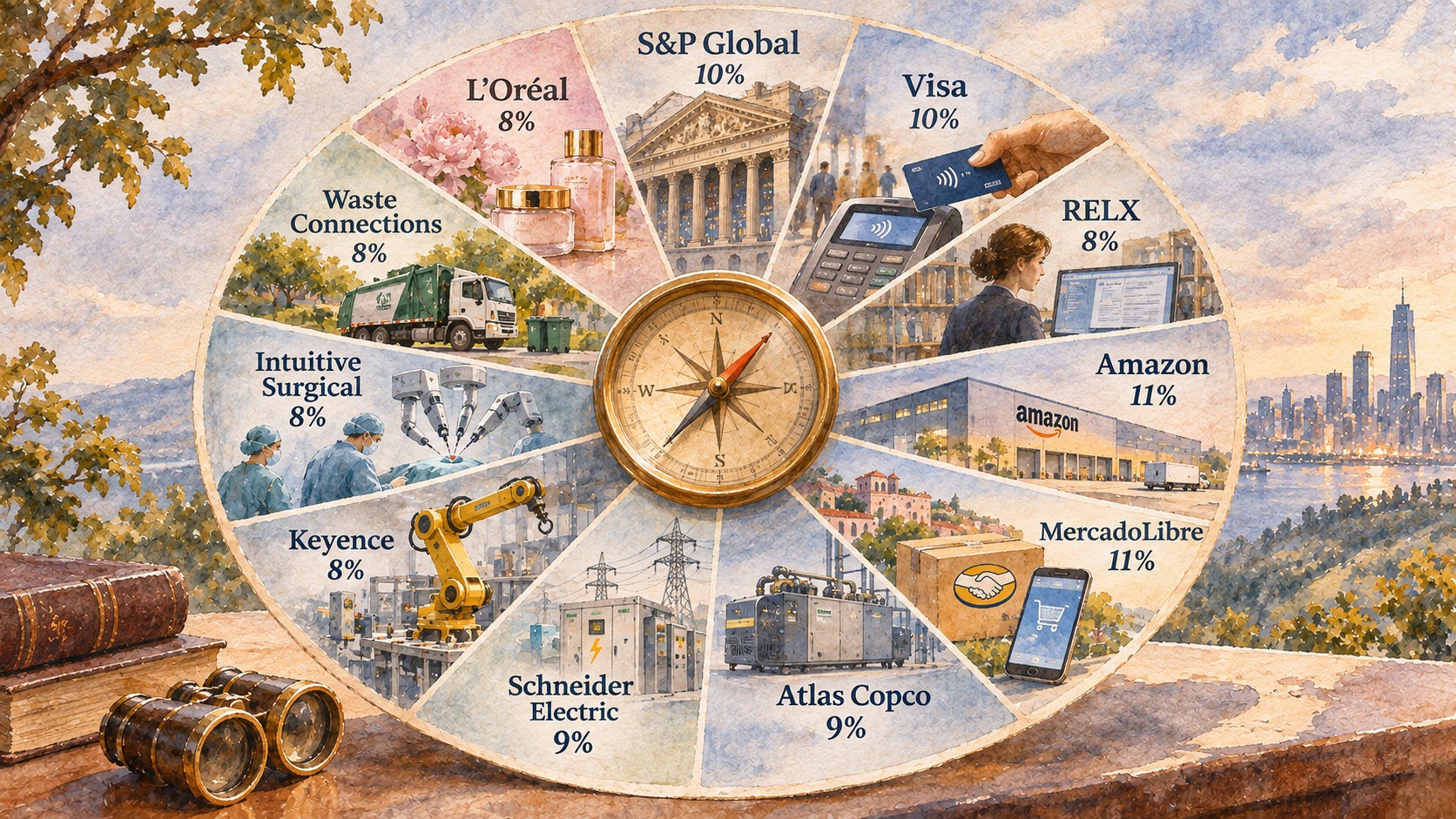
I have tried to imagine the world in 20-40 years and these are the businesses I think could have a good chance of doing well along with the development in the world. And I like how different these businesses are.
Some should benefit directly from technological progress. Others may benefit from becoming more efficient. Several offer exposure to economic activities that are likely to remain important regardless of which technologies dominate the headlines.
Let me explain the thinking behind the selections:
Financial infrastructure: S&P Global, Visa and RELX
One of the strongest patterns in the historical data is the value of businesses that become deeply embedded in the economy.
S&P Global provides ratings, indices and financial data. Visa operates a global payment network. RELX supplies specialised information and decision-making tools used by professionals.
These services are difficult to replace in many customer workflows.
As the economy becomes more digital, the demand for reliable information, payments and risk assessment may continue to grow.
AI could make their products better and their operations more efficient.
But there’s a risk too. New technologies could reduce the value of some services, while regulation and competition may limit their ability to raise prices.
I’d want to understand how durable their competitive advantages really are.
Digital platforms: Amazon and MercadoLibre
This is where Nick Sleep’s idea of scale economies shared becomes particularly interesting.
Companies can use their growing scale to improve services, reduce costs and offer customers better value.
More customers can lead to further improvements, which can attract even more customers.
Amazon has spent decades building distribution, technology and customer relationships. MercadoLibre is developing a similarly powerful ecosystem across commerce, payments, credit and logistics in Latin America.
Both have enormous opportunities.
But Amazon is also making exceptionally large investments in AI infrastructure, while MercadoLibre operates in competitive markets and carries additional economic and credit risks.
I’d want to know how much of their future growth will eventually reach shareholders as free cash flow.
Scale is valuable when it produces attractive returns on capital.
Industrial automation and electrification: Atlas Copco, Schneider Electric and Keyence
Here’s our exposure to the physical side of technological progress.
More automation requires equipment, sensors, control systems and reliable industrial infrastructure.
More electricity consumption requires investment in power distribution and energy management.
Atlas Copco supplies industrial equipment and services. Schneider Electric has an established position in electrical equipment and energy management. Keyence provides sensors, measurement equipment and machine vision technology used in automated factories.
All three operate in markets where reliability, specialist knowledge and customer relationships matter.
That reminds me of some of the industrial businesses that survived earlier technological revolutions.
But there’s an important catch.
Industrial investment comes in cycles. A surge in demand can encourage too much capacity expansion, and investors sometimes pay enormous multiples for peak earnings.
I’d want to examine profitability across full economic cycles before deciding what these companies are worth.
Healthcare and demographics: Intuitive Surgical
Populations are aging, and healthcare systems face growing pressure to become more efficient.
Intuitive Surgical is an interesting example because its robotic surgical systems create an installed base that generates recurring demand for instruments and services.
The company has opportunities to increase the number of procedures performed using its technology.
But medical technology is also competitive and heavily regulated. Hospitals must justify equipment costs, and reimbursement policies can affect demand.
Its long-term potential could be substantial. The price investors pay for that potential will be crucial.
Essential services and consumer brands: Waste Connections and L’Oréal
I wanted the portfolio to include businesses that don’t depend heavily on any particular technological revolution.
Waste Connections provides waste collection and related services. Its established routes, facilities and permits can create meaningful local competitive advantages.
AI and automation may help improve its operations, but the underlying demand for waste management is unlikely to disappear.
L’Oréal represents a different type of competitive advantage.
Its brands, distribution and customer relationships have been developed over many years. The global beauty market offers opportunities for growth, while technology may help improve product development, marketing and operations.
Both companies face competition, and neither is immune to poor management or overvaluation. But I like the idea of owning businesses that can become more productive without needing to invent an entirely new market.
And there are plenty of other candidates worth studying. Moody’s, Mastercard, Wolters Kluwer, Danaher, Ecolab, Costco, Wise and Sea could all fit different versions of this portfolio.
For this exercise, I wanted a manageable number of companies representing several distinct sources of economic value. The result still has risks. Eleven stocks are a concentrated portfolio, and several would be affected by the same global economic downturn or change in investor sentiment.
I like all 11 businesses in this portfolio. But would I buy them at today’s prices? That’s another question entirely.
For paid subscribers, I go deeper into company valuations, potential buying prices and the investments I actually make.
If that’s what you’re interested in, you’re very welcome to join.
Now let us go to the part that matters most:
4. The Actual Investment Plan
The portfolio above tells us which businesses I’d like to investigate.
It doesn’t tell us which shares to buy tomorrow.
And that’s an important distinction.
Imagine being offered a wonderful business at a price that already assumes twenty years of exceptional growth. Buying it might produce disappointing results, even if the company continues performing well.

That’s why I would approach this portfolio in stages.
First, understand the business.
Before buying anything: how does the company makes money? what protects its profitability and how it could lose its competitive position? Look at its customers, competitors, margins, capital requirements and historical returns on capital.
I’d also ask a question inspired by the lamplighter: What could make this business obsolete?
And if I can’t explain the answer clearly, I probably don’t understand the investment well enough.
Second, estimate its future economics.
How much can revenue reasonably grow? What will happen to margins? How much capital must the company reinvest? And how much free cash flow per share might it generate over the next decade?
I’d build conservative, normal and optimistic scenarios. I care much more about realistic returns than exciting forecasts.
Third, determine what I’m willing to pay.
For this example portfolio, I think we should aim for an expected annualized return of at least around 10% in my base-case valuation, before taxes and costs.
That’s an investment hurdle I’ve chosen for the exercise, rather than a return I expect every company to deliver. For riskier businesses, we demand a higher potential return or a larger margin of safety.
Examine the downside carefully. What happens if growth slows? What if margins decline? What if investors assign a lower valuation to the company ten years from now? The purchase price needs to leave enough room for things to go wrong.
Fourth, build positions patiently.
I would NOT buy all eleven companies simply to match the portfolio weights.
If only three companies offered attractive valuations, then those three would be the first I’d consider. The remaining capital could stay in cash or short-term investments while I continued researching.
I’d also consider the risk of having too much exposure to one country, currency, industry or economic factor.
Over time, I’d build the portfolio as opportunities appeared, rather than force the entire allocation into the market at once.
Finally, keep checking whether the investment thesis still holds.
The goal would be to own excellent businesses for many years.
But long-term investing doesn’t mean ignoring changes. So if a company’s competitive advantage weakens, its returns on capital deteriorate or management starts making poor investment decisions, I’d want to reassess the position.
And if the share price becomes so high that expected future returns are no longer attractive, I’d at least reconsider the opportunity cost of continuing to hold it.
The objective is to let strong businesses compound while remaining alert to the changes that could undermine them.
Back to the Lamplighter
I’m sure this example portfolio will look very different in twenty years. For good or worse. Some of the companies may disappoint. Others could become much larger and more profitable.
And there’s a good chance that some of the greatest investment opportunities of the next forty years haven’t even appeared yet.
The purpose of this exercise was to understand what history can teach us about investing through major economic changes. The Gilded Age gave us railroads, electricity, telephones and industrial machinery. Some companies became enormously successful, while others disappeared.
And many of the best investments were businesses that kept selling ordinary products, generating cash and reinvesting their earnings year after year.
We’re now living through another period of enormous change. AI, robotics, aging populations, electrification and digitalisation will create opportunities. They’ll also challenge businesses that have been successful for decades.
I don’t expect to predict every development, but I think we can improve our chances by focusing on businesses with durable competitive advantages, attractive returns on capital and the ability to remain relevant as the world changes around them.
Then comes the part we can actually control: how much we’re willing to pay.
I keep coming back to that young boy lighting the gas lamp. He was doing a job that had existed for generations, unaware of how much the world around him was about to change. A century and a half later, we’re watching another transformation take shape.
And as investors, we have a choice about which businesses we want to own through it.
I intend to keep looking for the ones that can benefit from progress, survive the inevitable setbacks and continue creating value for their shareholders.
At the right price, of course.
Well, that was quite a trip back to 1890!
I hope you enjoyed this little exercise as much as I did. There’s plenty more to explore, and I have a feeling we’ll find some very interesting businesses along the way.
If you’d like to follow along, subscribe for free.
And if you’d like to support my work and get access to the deeper company research, valuations and portfolio updates, consider becoming a paid subscriber.
Either way, thanks for reading. I appreciate it!
Sources and further reading
Dimson, Marsh & Staunton — Global Investment Returns Yearbook 2015
Siegel & Schwartz — Long-Term Returns on the Original S&P 500 Companies (2006)
Hendrik Bessembinder — One Hundred Years in the U.S. Stock Markets (2026)
The Lamplighter Portfolio is a hypothetical research exercise, not an investment recommendation or a portfolio valued at current market prices. Historical returns offer no guarantee of future performance.