


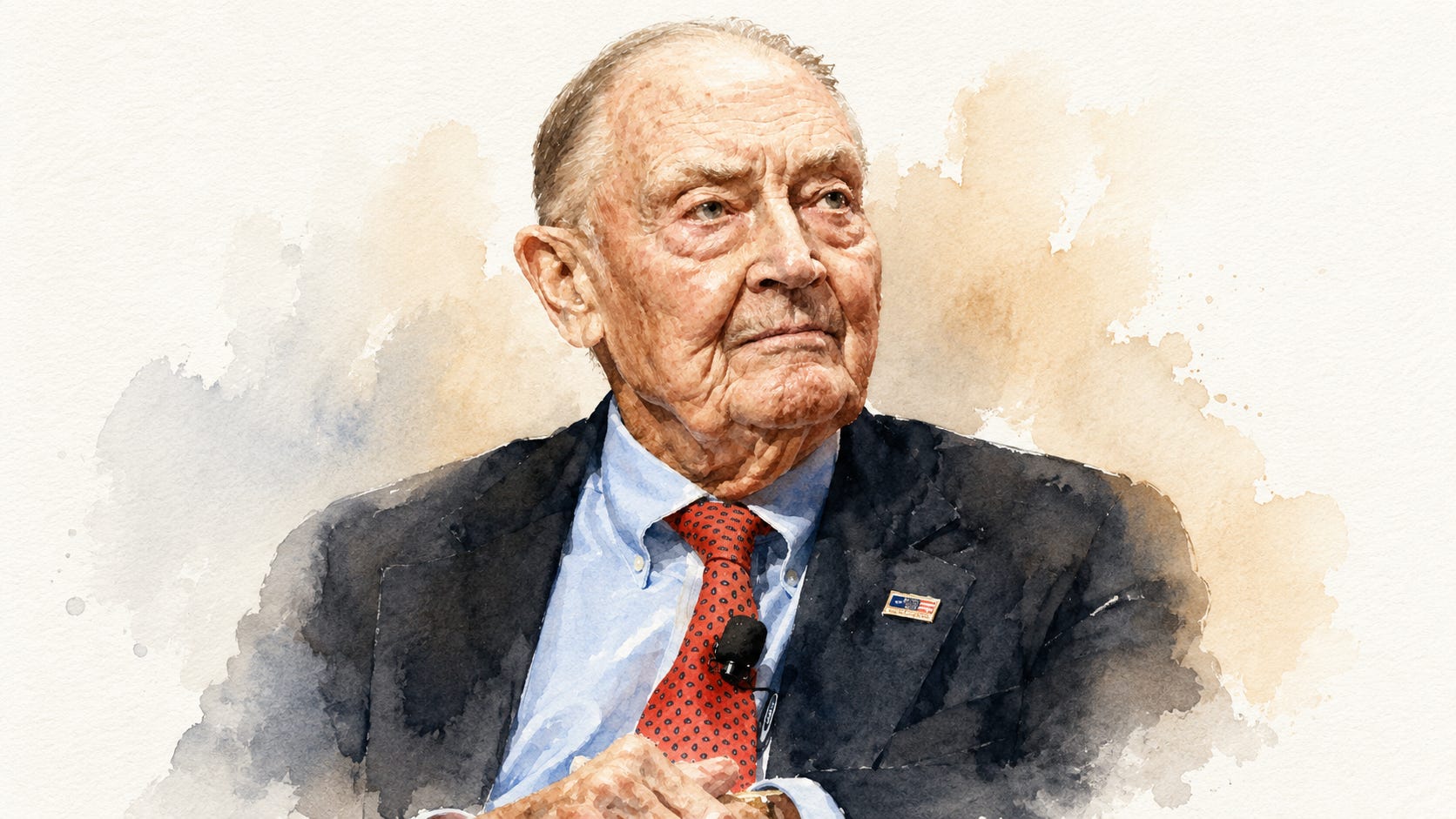
He never picked a stock. He never timed a market. He freely admitted, in writing, that he had no idea what the market would do next, and neither did anyone else.
Yet Jack Bogle built the largest asset manager in human history and, in doing so, transferred an estimated $1 trillion in fees away from Wall Street professionals and back into the pockets of ordinary investors.
His weapon was a mathematical identity so simple it fits on a napkin:
Gross Return − Costs = Net Return
That equation doesn’t look like a revolution. Wall Street spent fifty years hoping you’d never notice it was one.
The Origin Story
Jack Bogle and his twin brother were born into wealth on May 8, 1929, in Montclair, New Jersey. The timing was catastrophic. Within months, the Depression arrived and dismantled everything.
The family lost their home. They sold their possessions. His father, unable to bear the reversal, descended into alcoholism and eventually left.
Bogle grew up working, delivering newspapers, waiting tables, setting up bowling pins at a local alley. He got a precise, personal understanding of what it costs to earn a dollar and how quickly it can disappear.
He won a scholarship to Princeton, where he survived on work-study wages and developed the habit of reading everything. In 1949, a Fortune magazine article about the mutual fund industry caught his attention. The industry was young, loosely regulated, and making large promises about its ability to select superior stocks on behalf of investors.
Bogle spent his final two undergraduate years writing a 130-page senior thesis dismantling those promises. His central argument was blunt: mutual funds were not delivering on their claims, their fees were destroying the returns of the people they were supposed to serve, and their primary obligation should be minimizing costs, not maximizing the appearance of sophistication. He concluded that funds should aim simply to match the market, not beat it.
It was 1951. He was twenty-one years old.
Walter Morgan, founder of the Wellington Fund, read the thesis and hired Bogle immediately. Over the next fifteen years, Bogle rose to become CEO — disciplined, cost-conscious, relentlessly focused on the investor.
Then he made one catastrophic mistake.
The Firing

In the late 1960s, the market was euphoric.
Growth stocks were soaring. Bogle, under pressure to compete with flashier funds, and perhaps seduced by the bull market himself, approved a merger with Thorndike, Doran, Paine & Lewis, a Boston investment boutique known for aggressive, high-conviction growth stock picking.
The combined entity would manage Wellington’s conservative assets alongside the new firm’s speculative ones.
Then, in 1973 the market turned.
The growth stocks, built on optimism rather than earnings, collapsed. Wellington’s performance cratered. The board had seen enough. In January 1974, after a brutal internal vote, Jack Bogle was fired from the company he had spent his entire career building.
He was forty-four years old. His reputation was damaged. And the terms of his dismissal legally barred him from managing investments or running a fund advisory firm.
Most people would have left the industry. Bogle read the legal language very carefully.
The Superpower
What the firing prohibited was specific: Bogle could not manage money or run an investment advisory firm. What it did not prohibit was administration; the back-office mechanics of running a fund: legal, accounting, compliance, operations.
Bogle went back to the Wellington board with a proposal. He would form a new company, owned not by outside investors or private partners but by the Wellington funds themselves. This company would handle administrative functions only. It would, technically, not be an investment adviser.
He named it The Vanguard Group, after the British flagship at the Battle of the Nile.
The board approved it, assuming they were signing off on a clerical subsidiary. They had just handed Bogle the keys.
The ownership structure he designed was unlike anything in American finance. In a conventional asset management firm, investors pay fees that flow to the firm’s owners; shareholders, partners, executives. The firm’s incentive is to grow assets and extract maximum fees. The investor’s return is what’s left over.
At Vanguard, there were no outside owners. The funds owned Vanguard. The investors owned the funds. Any profits generated by the management company flowed back to reduce the costs borne by investors. The structure had no mechanism for extracting money from investors because investors were the owners.
[Traditional Asset Manager]  ──> Fees flow to ──> Outside Shareholders & Partners
[The Vanguard Structure]     ──> Profits flow to ──> Lower Costs for Fund Investors
This made one outcome structurally inevitable: Vanguard’s costs would always fall toward zero.
In 1976, Bogle launched the First Index Investment Trust; the first retail index fund available to ordinary investors, designed to track the S&P 500.
It held every stock in the index in proportion to its market weight. It hired no analysts. It made no predictions. It sought no edge. It simply owned corporate America and waited.
Wall Street called it “Bogle’s Folly.” The mockery was genuine. What serious investor would deliberately settle for average?
The answer, buried in the arithmetic, was: a very rational one.
Active funds were charging, on average, 1% to 1.5% annually in management fees. Add trading costs, tax drag from frequent portfolio turnover, and the spread paid on transactions, and the real cost of active management was routinely 2% or higher per year. That sounds modest. Compounded over decades, it is catastrophic.
On a $100,000 portfolio growing at 7% annually over 30 years:
On a $100,000 portfolio growing at 7% annually over 30 years: a 0.05% index fund leaves you with ~$757,000.
A 1% active fund leaves you with ~$574,000.
A 2% active fund leaves you with ~$432,000.
The difference between the first and last number is $325,000, paid entirely in fees, compounded against you over decades.
The “average” return, captured at near-zero cost, beat the majority of actively managed fund because of arithmetic.
The Graveyard
To own the market is to survive everything the market does to you.
There is no protection in Bogle’s approach. No analyst to raise cash when conditions deteriorate. No tactical allocation to shift into bonds at the first sign of trouble. When the dot-com bubble burst in 2000, index investors fell with it. When the 2008 financial crisis arrived, broad index funds lost roughly half their value in eighteen months.
Bogle’s entire architecture assumes you will not sell.
The moment you do, rattled by headlines, unable to stomach another month of losses, the mathematical advantage evaporates.
A 40% loss requires a 67% gain just to return to even. Selling at the bottom locks in the loss permanently and converts a temporary decline into a permanent one.
This is the only real skill the strategy demands: the ability to sit still while the world appears to be ending. It sounds easy. During a genuine panic, it is one of the hardest things an investor will ever be asked to do.
The Toolkit
Bogle’s philosophy reduces to three executable principles. They have been dressed up in many names by many commentators. The ideas themselves are deliberately plain, because their power comes from being followed.
Own the whole market, not pieces of it.
The moment you select individual stocks or sectors, you introduce the possibility of being wrong in ways that compound against you. The aggregate market, all of corporate America, all of its earnings, all of its dividends, grows over time because human productivity and commerce grow over time. That growth is yours to capture at near-zero cost. What you pay to capture it is the only variable fully within your control.
Make cost the first criterion, not the last.
Before evaluating any fund’s historical performance, calculate what it costs to own. An active fund returning 9% annually at a 1.2% fee has delivered 7.8% to you. A passive fund returning 8.5% at 0.05% has delivered 8.45%. The passive fund won because it was cheaper. Past performance shifts. Fees are contractual.
Remove yourself from the process.
Automate contributions. Set an asset allocation appropriate to your time horizon. Then do not watch it. The financial media exists to generate attention, not returns. Every analysis that makes you want to act is a cost, in fees, taxes, or mistimed decisions. The correct number of portfolio adjustments made in response to macroeconomic news headlines is, in Bogle’s view, approximately zero.
The Human Factor
Bogle’s heart was always the problem. He suffered his first heart attack at 31 and would endure two more, plus a cardiac arrest, over the following decades. He lived for years with a pacemaker, acutely aware that his time was limited. In 1996, at 65, he received a heart transplant that granted him twenty-two additional years of uncompromising work.
He used them loudly. And, near the end, in unexpected ways.
Despite founding the firm that made index investing mainstream, Bogle spent his later years as a vocal critic of what index investing had become.
The explosion of exchange-traded index funds, which trade throughout the day like stocks, enabling precisely the speculative behavior he had spent his career fighting, troubled him deeply.
He was not opposed to indexing. He was opposed to trading. An ETF, he argued, was a vehicle designed to help people who couldn’t help themselves do exactly that, wrapped in the philosophy of a strategy that required them not to.
He was, in his final decade, openly at war with his own legacy. The idea had been captured and repackaged by an industry that had never fully understood it. Or, perhaps, had understood it perfectly and simply declined to follow it.
Had Bogle structured Vanguard as a conventional for-profit firm, his personal stake would have been worth tens of billions of dollars. Instead, at his death in January 2019, his net worth was estimated at around $80 million.
A substantial fortune, but a rounding error against what he had deliberately walked away from. He flew coach. He lived in the same modest house for decades. He kept a bagged lunch at his desk.
He once said, with characteristic plainness: “I have had a wonderful life. I have done what I wanted to do, and I have done it on my own terms.”
The Verdict
Bogle’s philosophy is not a strategy for people who want to feel clever. It offers no stories to tell at dinner, no moments of vindication when a bet pays off, no individual genius to point at. What it offers instead is something rarer: a mathematically grounded approach to not losing to your own costs, your own impatience, and your own overconfidence.
This philosophy rewards you if:
Your investment horizon is measured in decades, not quarters.
You are more interested in the near-certainty of a good outcome than the remote possibility of a spectacular one.
You can watch your portfolio fall 40% without interpreting it as a signal to act.
Walk away if:
You believe you have an informational or analytical edge over institutional investors with billion-dollar research budgets.
You need the engagement of active management to stay interested in investing at all.
You cannot sit still.
The rest is just arithmetic. Bogle spent his life insisting that was enough.
“The greatest enemy of a good plan is the dream of a perfect plan. Stick to the good plan.”
― John C. Bogle