



The Man Who Sold America
On the evening of October 29, 1929, the Livermore estate was in a state of funeral panic.
While the rest of New York City was reeling from “Black Tuesday”—with traders sleeping on office floors and fortunes vaporizing into thin air—Jesse Livermore walked through his front door. His wife, Dorothy, and her mother were weeping. They had heard the news of the market’s total collapse and assumed they were destitute.
Livermore looked at them, confused.
While the world was buying, he had sensed a shift. He had spent days living out of his office, aggressively shorting the market. He looked at his terrified wife and delivered the news:
“We aren’t ruined. I just had the best trading day of my life.”
In a single session, he had cleared $100 million. Adjusted for inflation, that is roughly $1.5 billion today.
He was the “Boy Plunger.” The man who J.P. Morgan once personally begged to stop trading. But his story isn’t just about the money he made—it’s about the demons that eventually came to collect it.
The Origin Story: The Prodigy in Disguise
Jesse Livermore was not normal. He was a computational anomaly born into a family of farmers.
He learned to read and write by age three and a half. By age five, he was ignoring storybooks to devour the financial pages of the newspaper. His father, a pragmatist who saw no value in books, pulled him out of school at age 14 to work the farm. Jesse responded by packing a bag and escaping to Boston with nothing but a few dollars in his pocket.
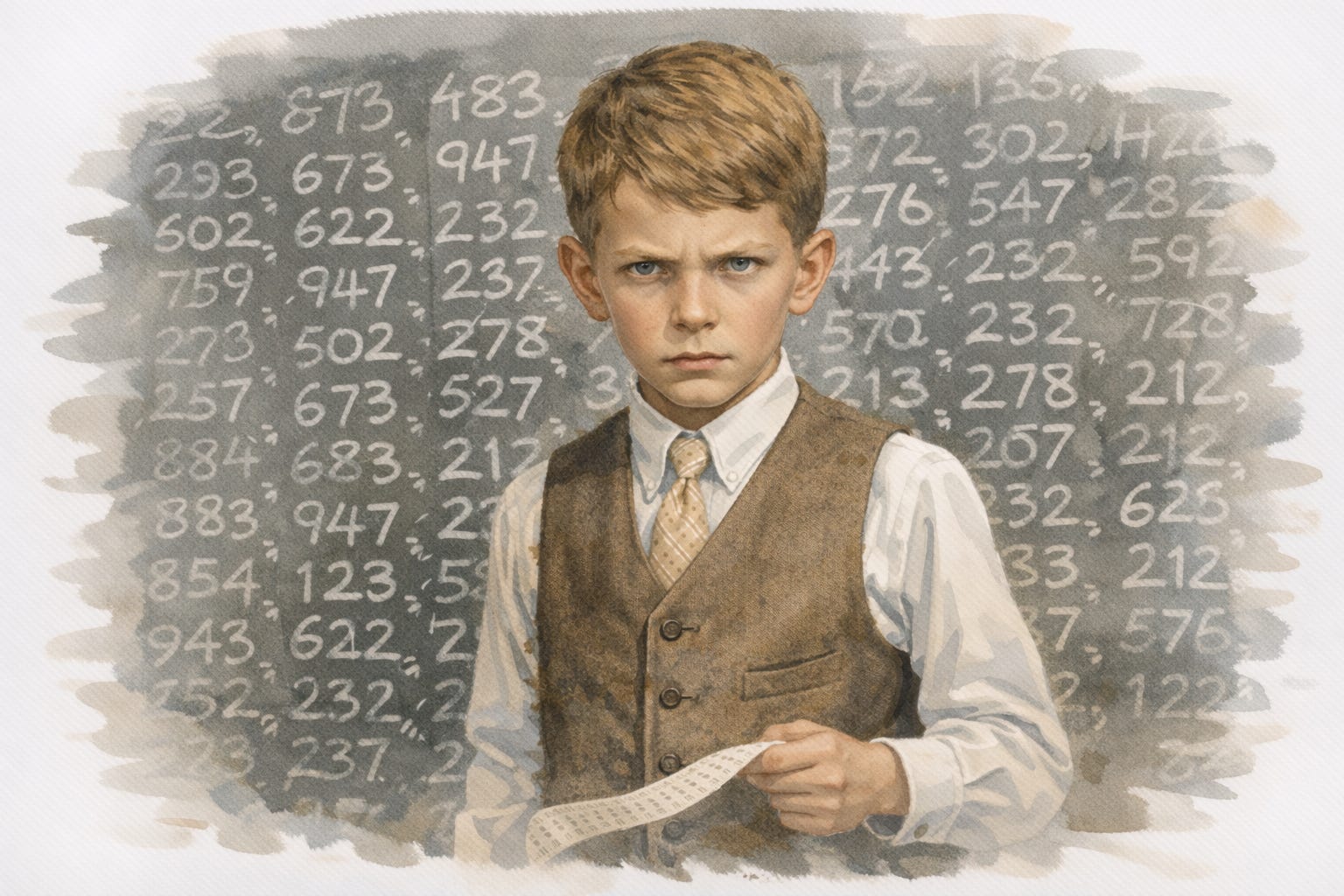
He charmed his way into a job as a “board boy” at Paine Webber for $5 a week. His job was to update stock prices on a giant chalkboard as they came in over the wire.
This was his “10,000 Hours.” By staring at the numbers all day, he realized they weren’t random. They had a rhythm. At age 15, he made his first trade in a “bucket shop” (an off-exchange gambling hall). He risked $5 and made a profit of $3.12.
He became so lethal at predicting prices that the bucket shops started losing money. They banned him. But Livermore wasn’t done. He bought a fake beard, donned a disguise, and went right back in to fleece them again.
By age 20, he was banned permanently, but he walked away with his first small fortune: $10,000.
The Superpower: The “Psychic Surge”
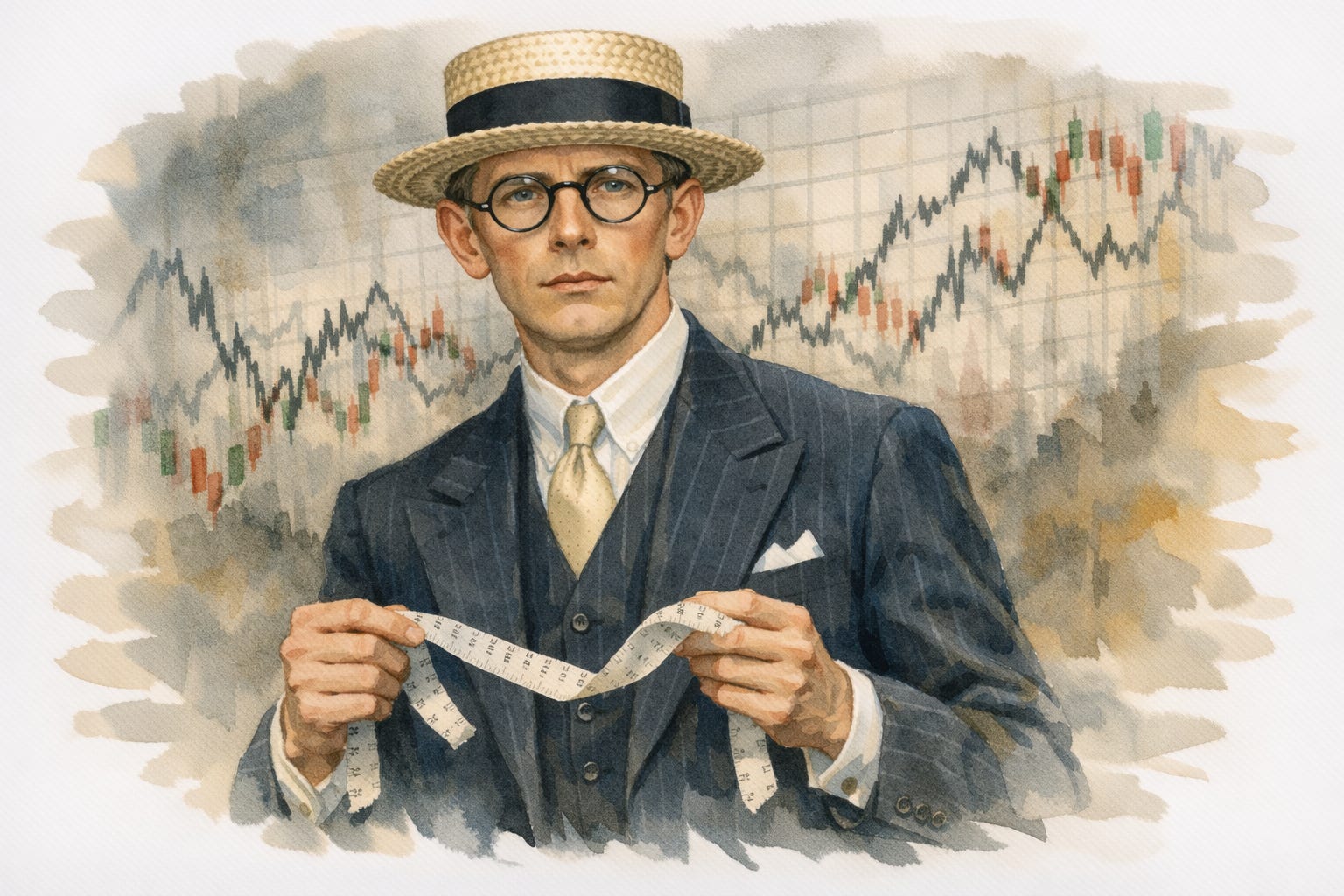
Livermore’s genius was his ability to fuse Tape Reading with Gut Instinct.
He didn’t care about the company’s “value.” He only cared about price action. His most famous trade wasn’t based on data, but on a “psychic surge.”
The Earthquake Short (1906)
In 1906, Livermore was on vacation in Palm Beach. Suddenly, he felt a visceral urge to short Union Pacific stock. He couldn’t explain it. The stock was in a bull run. His friends told him he was crazy.
He shorted it anyway.
Days later, the great San Francisco earthquake hit. The city was leveled. Union Pacific tracks were destroyed. The stock plummeted, and Livermore pocketed $250,000.
It wasn’t magic. It was his subconscious processing thousands of micro-data points from the ticker tape that his conscious mind couldn’t articulate. He learned to trust the “tape” over everything else.
The Graveyard: The “Tip” That Cost $5 Million
To understand Livermore, you must understand his specific weakness. He was invincible when he traded alone. He was vulnerable when he listened to others.
His “Kryptonite” was the Inside Tip.
In 1908, he was befriended by “Teddy” Price, a famous cotton trader. Livermore had built his fortune to $5 million. Price convinced Livermore that the cotton market was going up. Livermore respected Price, so he violated his own rules. He stopped reading the tape and started listening to the “expert”.
While Price was telling Livermore to buy, Price was secretly selling.
The market collapsed. Livermore lost everything. He went from a $5 million fortune to bankruptcy in a single year.
The Lesson: “No man can always have adequate reasons for buying or selling stocks daily - or sufficient knowledge to make his play an intelligent play.”. The moment you outsource your thinking, you outsource your survival.
Steal Their Brain: The Livermore Toolkit
Livermore’s life was volatile, but his rules were ironclad. Here is the operating system he used to turn bankruptcy into millions, repeatedly.
1. The “Probe” System
Livermore never went “all in” at the start. He used probing positions.
The Concept: When he bought his first share at age 15, he risked a tiny amount ($5) to test his thesis.
The Action: Buy a small amount. If the price moves in your favor, the market is confirming you are right. Then you add to the position. If it moves against you, cut it immediately.
2. Beware the Lag
Why did Livermore lose his first fortune in New York?
The Concept: In the bucket shops, prices were instant. In New York, the ticker tape lagged 30 to 40 minutes behind reality.
The Action: Understand your data latency. If you are trading on old information, you are the “sucker” at the table.
3. Desperation is an Edge
Livermore was a “Phoenix.” He went bankrupt three times, and each time he rose from the ashes richer than before. Why? Because he had to.
The concept: When he married his third wife, Harriet Metz, she had a massive inherited fortune ($7 million).
The Risk: The safety net killed him. His wife’s fortune “lulled him into a sense of comfort and killed the desperation to win”. Without the fear of poverty, he lost his edge.
The Human Factor: The Curse of the “Boy Plunger”
Livermore lived a life of Gatsby-esque excess.

The Highs: After his 1907 win, he bought a $200,000 yacht and a private rail car to mimic J.P. Morgan. He had a stream of mistresses, including dancers from the Ziegfeld Follies.
The Lows: His family life was a horror story. His wife Dorothy became an alcoholic. In a drunken Thanksgiving argument, Dorothy actually shot their son, Jesse Jr. (He survived).
In the end, the market changed. The creation of the SEC in 1934 regulated the wild swings Livermore relied on. He felt he had lost his “touch.”
In 1940, sitting in the cloakroom of the Sherry Netherland Hotel, the man who had owned Wall Street took his own life. He left almost no money to his children.
He left a note to his wife:
“My life has been a failure. I am tired of fighting."

The Verdict
Jesse Livermore is the father of trend following. He proved that price is the only thing that matters.
Copy this style if:
You are a trader, not an investor.
You believe “the trend is your friend.”
You have the discipline to cut a loser instantly without emotion.
Run away if:
You are a “Value Investor” (Livermore didn’t care about value; he cared about price).
You want to “buy low and sell high” (Livermore bought high and sold higher).
You cannot handle volatility.
Livermore taught us that the stock market is the most dangerous place on earth because it acts as a mirror. It doesn’t just show you prices; it shows you your own greed, fear, and stupidity.
“The game of speculation is the most uniformly fascinating game in the world. But it is not a game for the stupid, the mentally lazy, the person of inferior emotional balance, or the get-rich-quick adventurer. They will die poor.” — Jesse Livermore
Great post, Rob!