



If you had invested £10,000 in the global stock market (MSCI World) when Fundsmith launched in 2010, you would have a respectable pile of cash today.
But if you had given that same £10,000 to Terry Smith, a combative history graduate who manages money from a tropical island, you wouldn’t just be rich; you would be nearly three times wealthier than the average investor.
Terry Smith has built a £23 billion+ empire not by trading faster than the machines, but by doing something radical:
Absolutely nothing.
He is the “English Warren Buffett,” a man who thinks most fund managers are “closet indexers” charging champagne fees for lemonade performance. His strategy is so simple it almost feels illegal: Buy the best companies in the world, and then go to the beach.
The Origin Story: The Analyst Who Knew Too Much
Terry Smith didn’t start as a billionaire fund manager. He started as the guy “everyone” wanted to fire.
Born in London in 1953, Smith studied history, not economics. This is his secret weapon. While other analysts were drowning in Excel sheets, Smith was trained to spot “official narratives” and dismantle them.
In the 1980s and 90s, he became the most dangerous man in the City of London:
The Barclays Betrayal: As a top banking analyst, he issued a “Sell” rating on Barclays (his own former employer) days before they announced a disaster. He was right.
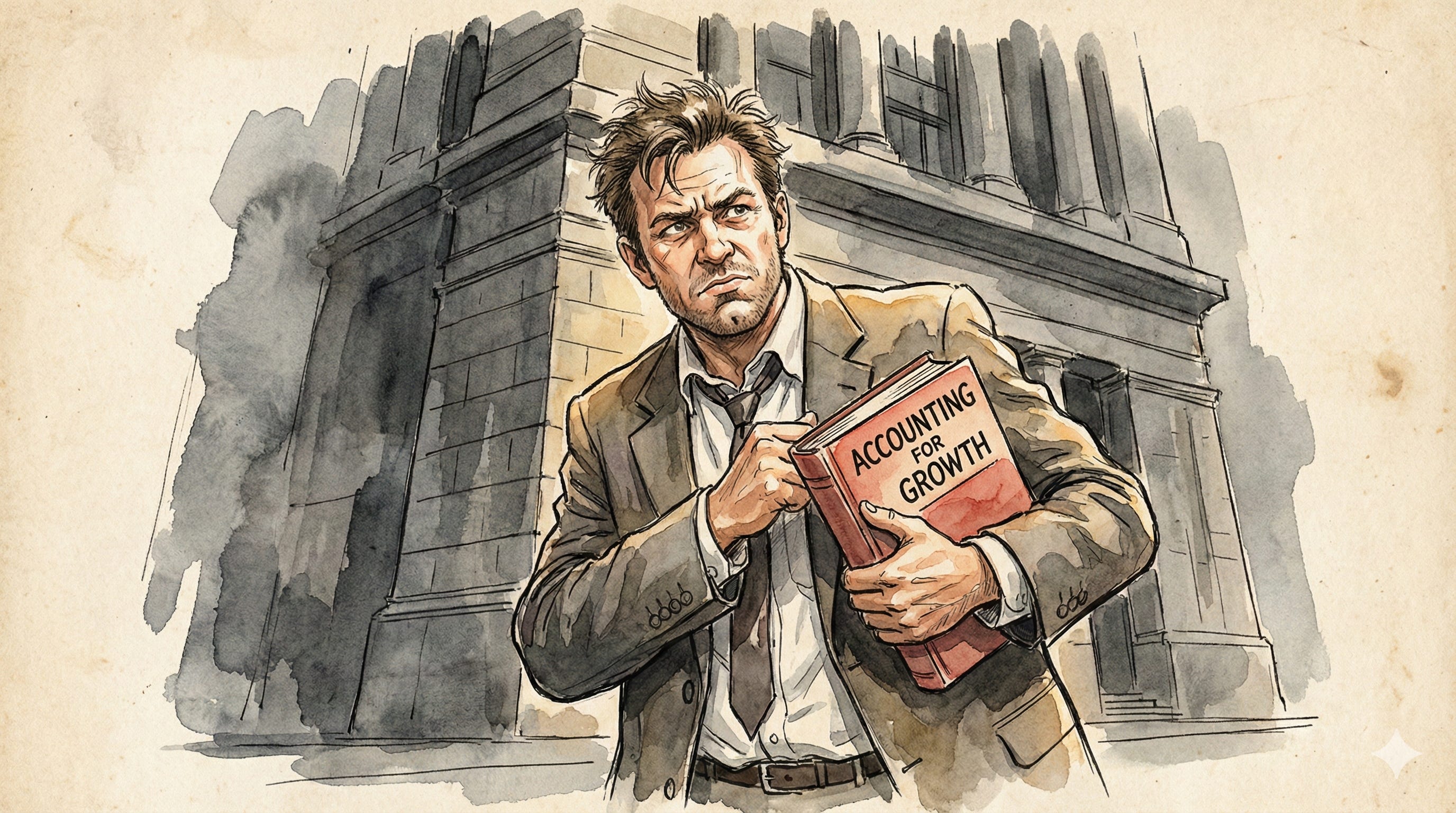
The Accounting Assassin: In 1992, he wrote Accounting for Growth. The book was a grenade thrown into the London Stock Exchange, exposing how companies used “creative accounting” to fake their profits. UBS, his employer, told him to withdraw the book or be fired. Smith published it anyway. He was fired, the book became a bestseller, and a legend was born.
The Superpower: The “Quality” Obsession
Smith’s philosophy is a rejection of the “Buy Low, Sell High” gambling addiction. He believes there are only two types of companies: those you want to own, and those you don’t. Price is secondary.
He operates on a brutal three-step algorithm:
Buy Good Companies: Ignore 98% of the market. Only look at companies that have already won.
Don’t Overpay: Use Free Cash Flow Yield, not P/E.
Do Nothing: This is the hard part. Fundsmith’s turnover is often <5% per year. He buys a stock and holds it for decades.
How to Screen for Stocks Like Terry
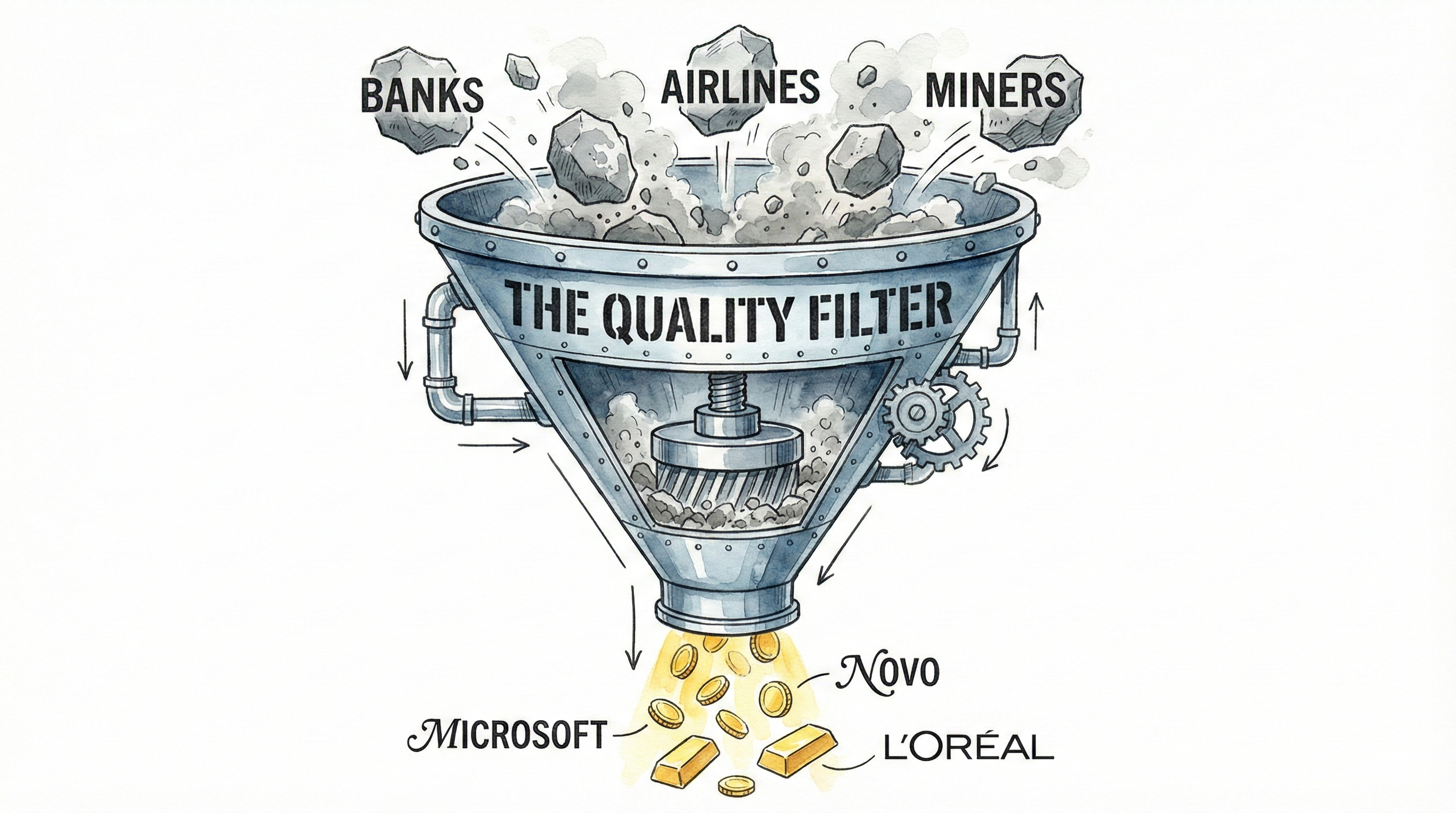
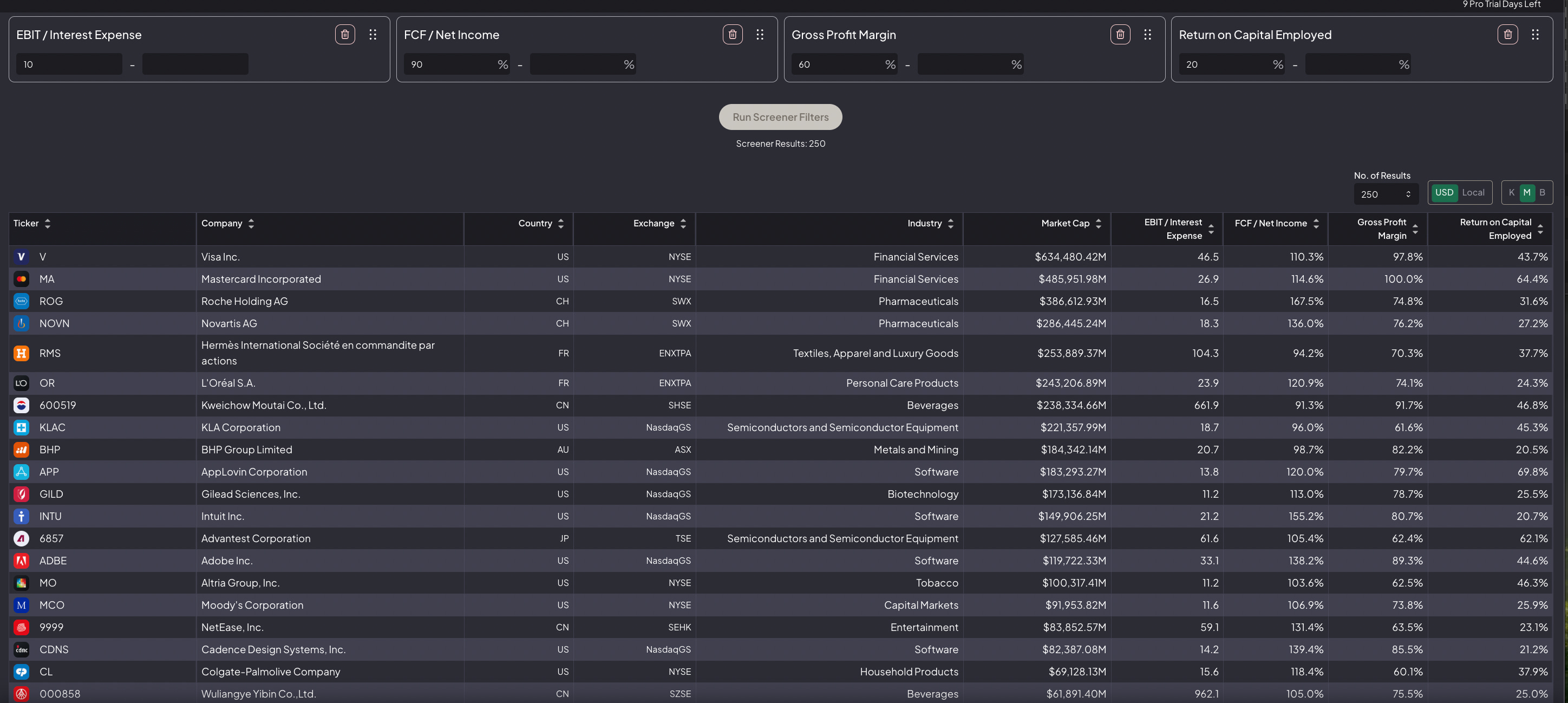
You don’t need a Bloomberg terminal to find a “Smith Stock.” You have the exact tools right in front of you. Based on your screener setup, here are the four “Golden Metrics” to input:
1. The Engine: Return on Capital Employed > 20%
Why: This measures efficiency. For every dollar the company invests in itself, how much profit does it generate? Smith demands a consistent ROCE of over 20%. If a company can’t generate high returns on its own money, why should it generate returns on yours?
2. The Shield: Gross Profit Margin > 60%
Why: High margins mean pricing power. If inflation hits and ingredients get expensive, a company like L’Oréal (80% margins) can absorb the cost. A supermarket (3% margins) cannot. High margins are your shield against inflation.
3. The Lie Detector: FCF / Net Income > 90%
Why: “Profit” is an opinion; Cash is a fact. This metric (often called Cash Conversion) tells you if the profits are real. Smith demands that for every $1 of reported Net Income, at least $0.90 actually hits the bank account as Free Cash Flow.
4. The Fortress: EBIT / Interest Expense > 10x
Why: This is your Interest Coverage. Debt kills. Smith hates leverage. He wants companies that earn enough profit (EBIT) to pay their interest bill 10 times over without blinking.
The Graveyard: The AI Miss
To invest like Smith, you must be willing to look “stupid” during a mania.
Smith’s rigorous focus on history and proven cash flows means he often misses the “Next Big Thing.”
The Failure: Between 2021 and 2024, Fundsmith lagged the market. Why? Because he owned zero NVIDIA.
The Reason: He viewed the AI hardware boom as a cyclical hype cycle, similar to the Dot-Com bubble. While the “Magnificent 7” soared, Smith stayed on the sidelines.
The Lesson: This strategy protects you from total ruin, but it guarantees you will underperform when the market goes parabolic on speculation.
Steal Their Brain: The Toolkit
1. The “Mayonnaise” Test Smith famously attacked Unilever for obsessing over the “brand purpose” of Hellmann’s Mayonnaise.
The Actionable Rule: Read a company’s Annual Report. If they talk more about “saving the planet” or “social purpose” than they do about operating margins or return on capital, sell the stock. They have lost focus.
2. The “Bookie” Mental Model Smith loves businesses that take a small cut of a huge volume of small transactions. Think Visa, Mastercard, or Amadeus.
The Actionable Rule: Look for “Toll-Booth” stocks. You don’t want to bet on who wins the football game; you want to own the ticket gate.
3. The “Cocaine” Check Smith compares share buybacks to cocaine: “You get a cheap high for a while, but eventually it kills you.”
The Actionable Rule: Check the valuation. Is the company buying back its own stock at an All-Time High P/E ratio? If yes, management is destroying value to boost their EPS bonuses. Avoid.
The Human Factor: The Combative Islander
Terry Smith is not a suit-wearing wallflower. He runs his empire from Mauritius, an island in the Indian Ocean, far away from the “noise” and groupthink of London and New York.
He is famously frugal with his fund’s operations but lavish with his opinions. His annual letters are legendary for their “acerbic wit,” often openly mocking the companies he owns if they misbehave. He is a man who would rather be right than be popular.

The Secret Library
You might think a fund managing over £20 billion would be too busy to talk to the “little guy.” You’d be wrong.
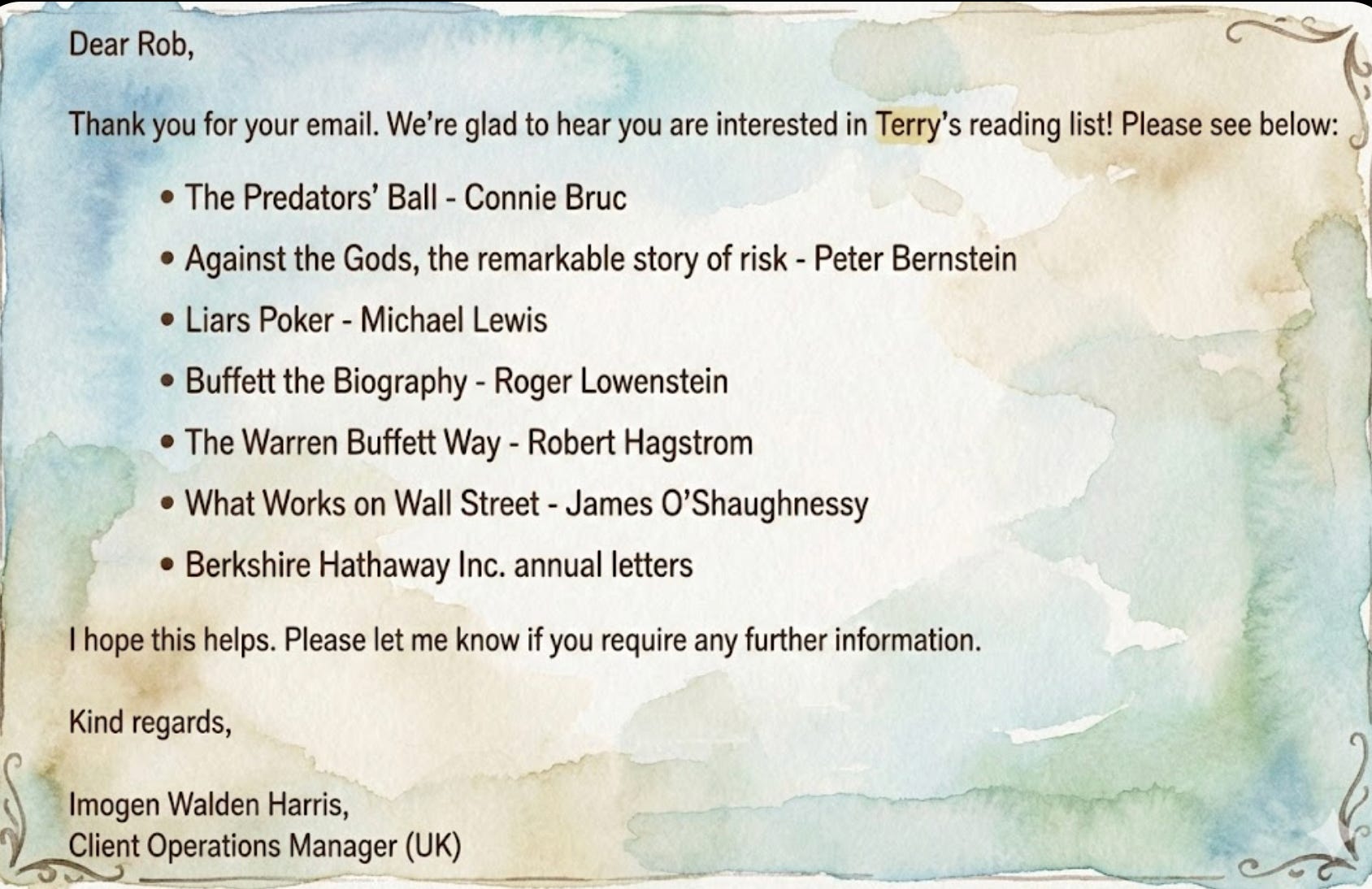
I actually contacted Fundsmith myself a little while ago, simply asking for reading recommendations to better understand his philosophy. I expected an automated reply, or even silence. Instead, they personally responded with a curated list of books that shaped Terry’s worldview.
It wasn’t a list of “Get Rich Quick” manuals; it was a syllabus on history, skepticism, and accounting. It proved that Fundsmith isn’t just a fund; it’s an educational project disguised as an asset manager.
The Verdict
Terry Smith is the ultimate antidote to the “Get Rich Quick” crypto culture.
Copy this style if:
You have a “coffee can” mentality (buy it and forget it for 10 years).
You prefer boring winners (cosmetics, medical devices, software) over exciting gambles.
You value Free Cash Flow above all else.
Run away if:
You need to own the “hot stock” of the month (NVIDIA, Tesla).
You get anxious when your portfolio doesn’t change for six months.
You believe “Valuation” (P/E) is the most important metric. (Smith believes Quality > Valuation).
The Final Word: “Stop trying to be smart. It’s better to be right.”
This is the investing equivalent of that one friend who refuses to upgrade their 10-year-old Toyota because "it just works" and "repairs are cheap." While you’re flashing your new Tesla (NVIDIA) that goes 0-60 in 3 seconds, he’s lecturing you about depreciation and battery replacement costs.
He might be right in 10 years, but right now, he looks like a dinosaur while you’re zooming past him on the highway. It’s a reminder that being "prudent" often feels like being "boring" and "wrong" while everyone else is partying.