


I write 20-page deep dives because I love digging into the numbers.
But I create these ‘Simple Truths’ summaries because I know not everyone have time read my ultra-long content.
My goal is simple: I do the hours of heavy lifting (stripping away the corporate jargon and complex tables) to hand you the pure signal.
Here is my full research on Duolingo, distilled into a 3-minute read that respects your time.
1. The Napkin Pitch
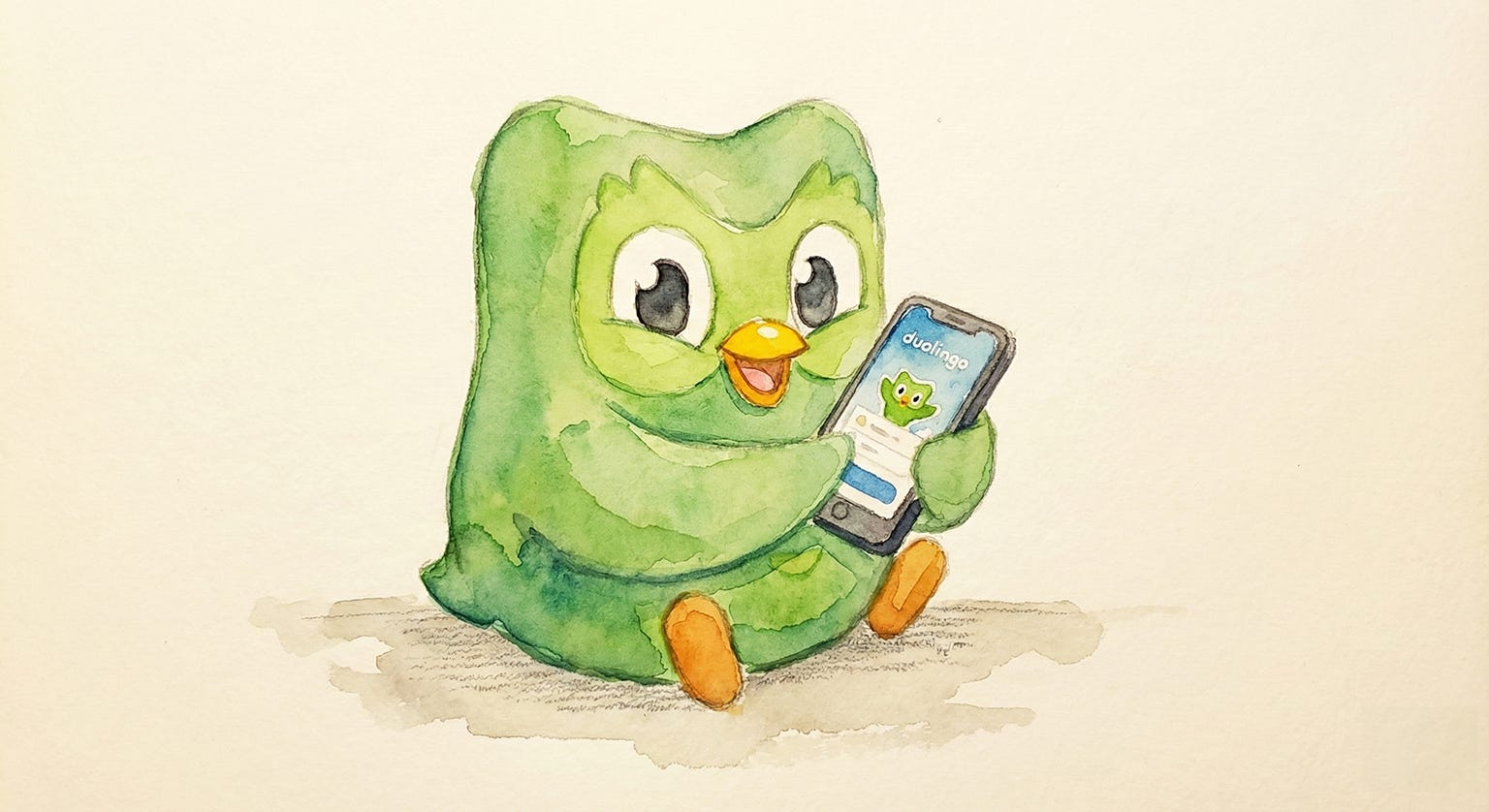
The One-Liner: Duolingo is a cash-printing machine disguised as a silly owl; it has convinced 50 million people to make “self-improvement” a daily addiction.
The “Back of the Napkin” Thesis:
Addictive Utility: They have gamified learning so effectively that 50.5 million people use it every single day.
Cash Fortress: They have over $1.1 billion in liquid cash and very little debt, meaning they can afford to play the long game.
Margins of Safety: For every $1 they bring in, they keep nearly 29 cents as pure cash profit (Free Cash Flow).
The “Unhinged” Brand: Their marketing is viral genius (the “crazy owl”), allowing them to acquire millions of users without spending a fortune on ads.
2. Business Model
What they sell:
Language lessons (and recently math and music) broken down into bite-sized, game-like sessions. They sell the feeling of being productive on your phone instead of doom-scrolling.
The Customer:
There are two types of customers here:
The Free User: They pay with their attention by watching ads.
The Subscriber: Roughly 9 out of every 100 users pay a monthly or annual fee to remove ads and get extra features.
How the cash enters the building:
It is a “Freemium” model, but make no mistake: this is a subscription business.
Subscriptions: ~85% of their revenue comes from people paying for Super Duolingo or Duolingo Max.
Other Stuff: A smaller chunk comes from ads, English proficiency tests, and in-app purchases.
3. The Moat (Why They Win)
The “Toothbrush Test”:
Pass. 50.5 million people use this app daily. The engagement is incredibly sticky; a poll showed 33% of users continue their streak simply because they are “terrified to lose it.
Why competitors can’t steal it:
The Streak is a Drug: Users have invested years into their “streaks.” Leaving Duolingo means losing that social badge of honor.
Data Scale: With 135 million monthly active users, Duolingo has more data on how people learn than almost anyone else. They use this to constantly tweak the app to make it more addictive.
Brand Distribution: The “Duolingo Owl” is a viral meme icon. They can turn a dial labeled “Chaos” on social media to drive user growth whenever they want.
4. The Price Tag (Valuation)
Here is the corrected Valuation Section, keeping the FCF Margin as requested and adding the FCF Yield. This uses the “Clean List” format for perfect Substack compatibility.
4. The Price Tag (Valuation)
Current Stock Price: ~$173.87 (as of Jan 2026)
The market used to price this stock for “perfection.” Now, after a price drop, it is priced for “execution.” It’s still not cheap, but for the first time in a while, it is offering a real cash return.
1. Free Cash Flow (FCF) Yield: ~3.6% (Est.)
The Translation: The “Interest Rate.”
What it means: If you annualize their recent cash generation ($77.4M in Q3), the stock is paying you a theoretical ~3.6% yield on your investment.
The Verdict: This is surprisingly high. Usually, with high-growth tech stocks, you get a 0% yield today in exchange for growth tomorrow. Here, you are getting 41% revenue growth and a yield that nearly rivals a savings account.
2. Free Cash Flow Margin: 28.5%
The Translation: The Cash Efficiency.
What it means: This measures how good they are at turning sales into actual money in the bank. For every $100 of revenue they bring in, they keep $28.50 as pure cash profit.
The Verdict: Elite. Most software companies dream of hitting 20%. Duolingo is nearly at 30%, proving their business model is incredibly efficient.
3. EV / EBITDA: ~25.3x
The Translation: The “Buyout” Price.
What it means: If you bought the whole company today, you are paying roughly 25 times its annual operating profit.
The Verdict: This is the “Growth Premium.” A boring utility company trades at 10x; a hyper-growth tech stock often trades at 50x. At 25x, Duolingo is priced right in the middle—expensive, but reasonable for a market leader.
4. P/E Ratio: Ignored
The Translation: The Trap.
What it means: We are ignoring the standard “Profit” ratio because a massive $222 million one-time tax benefit made their earnings look artificially huge this quarter.
The Verdict: Do not trust the P/E ratio on Yahoo Finance right now; stick to the cash flow.
The Cash Verdict: You are paying a premium price (25x EBITDA), but you are buying a “compounder”—a business that is growing revenue at 41% while still generating a healthy 3.6% cash yield and elite 28.5% margins. That is a rare combination of growth and safety.
5. The Money (Financial Health)
Profitability:
They are printing cash.
Gross Margin: 72.5%. This is high, though it dipped slightly because running Artificial Intelligence (AI) is expensive.
Free Cash Flow: In Q3 alone, they generated $77.4 million in cold, hard cash.
The Balance Sheet:
This is a “sleep well at night” balance sheet.
Cash: They have over $1.1 billion in cash and investments.
Debt: They have total liabilities of roughly $578 million, meaning they could pay off everything they owe tomorrow and still have half a billion dollars left over.
Hidden Asset: They have $441.7 million in “Deferred Revenue”. This is cash they have already collected from subscribers but haven’t “counted” as revenue yet. It’s a great safety cushion.
6. Skin in the Game (Management)
The Driver:
The founders and management are focused on the long term. In their recent letter, they explicitly stated they are prioritizing “teaching better” over short-term monetization tweaks.
The Alignment:
They are willing to take a hit on short-term margins (paying for expensive AI) to build a better product for the future. This is exactly what you want a founder-led company to do. They aren’t trying to juice the quarter; they are trying to win the decade.
7. The Bear Case (Risks)
The Kill Switch (What could ruin this):
Rented Land: Duolingo does not own the store; Apple and Google do. Roughly 85% of their revenue is processed through the App Store and Play Store. If Apple or Google decide to double their fees or ban the app, Duolingo is in big trouble.
The “Worry List”:
Brains are Expensive (AI Costs): The gross margin dropped because AI computing costs are high. If AI costs rise faster than subscription prices, their profits will shrink.
Engagement Fatigue: There is no contract locking users in. If people get bored of the owl or the gamification stops working, the users can leave instantly.
The “Optical Illusion”: Investors who only look at “Net Income” might be fooled by a massive one-time tax benefit this quarter. If the stock price is based on that fake number, it could crash when reality sets in.
8. The Summary
I like this stock because it is a rare “Consumer Compounder.” It has the addictive nature of a video game, the recurring revenue of a utility company, and the balance sheet of a bank. It is expensive, but high-quality things usually are.
There is a complex “accounting magic” happening with their Deferred Revenue account. They are collecting cash much faster than they are allowed to report it as revenue, which means the business is actually stronger than the basic earnings report suggests.
So! This was just the appetizer. The full deep dive will of course have lots more to digest.
For the full deep dive into how their “Deferred Revenue” acts as a secret war chest, read the full Duolingo analysis here.
Do you enjoy complex Deep Dives distilled into a simple 3-minute read? ⏳
Do a friend (and me) a huge favor: Forward this to a busy investor who values quality over quantity.
Disclaimer:
I Am Not Your Financial Advisor: I am a researcher sharing my homework, not a wealth manager giving you a plan. This is for education, not a recommendation to buy or sell.
I Am Biased: $DUOL is one the largest positions in my personal portfolio. I have skin in the game and I want this company to win. Read this with that in mind.
The Golden Rule: It is your money. Do your own due diligence, read the actual filings, and never invest money you cannot afford to lose.