


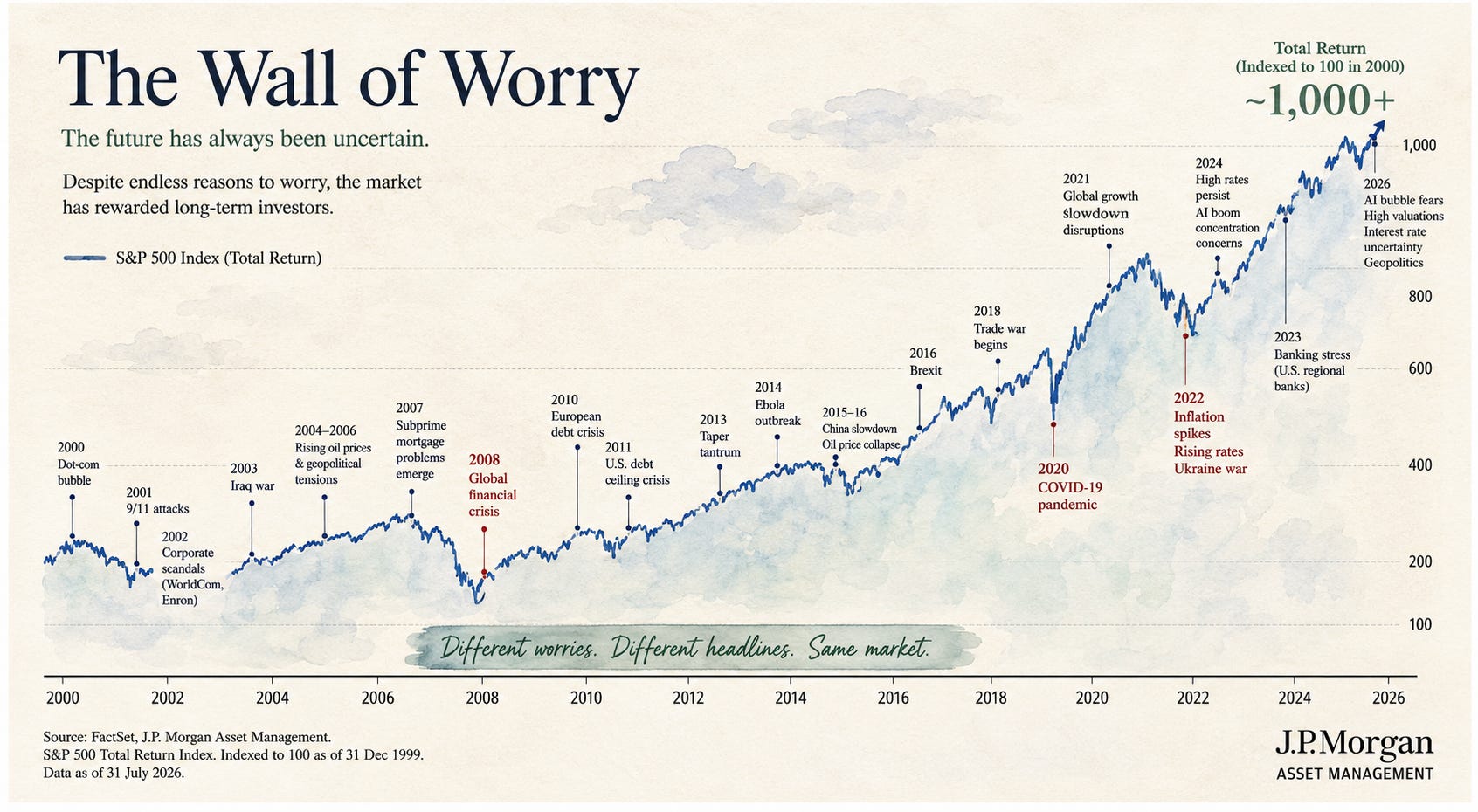
I came across a headline in a financial newspaper this weekend:
“Stock market analyst warns about risks on Wall Street.”
I am not going to spend this article debating whether the analyst is right or wrong, because the risks being highlighted may very well be real.
No… Something else struck me.
I have read this many times before. Maybe with a different analyst, and maybe with a different risk attached.
But the story was the same: The market has risen a lot. Valuations are high. Investors are too optimistic. There are risks out there that the market may be underestimating. A correction could be coming.
How often do we actually read articles like this?
Turns out, the answer is: very often.
Keep reading, and you will discover some interesting facts.
There Is Always a Reason to Be Afraid
Let’s go back just a few years:
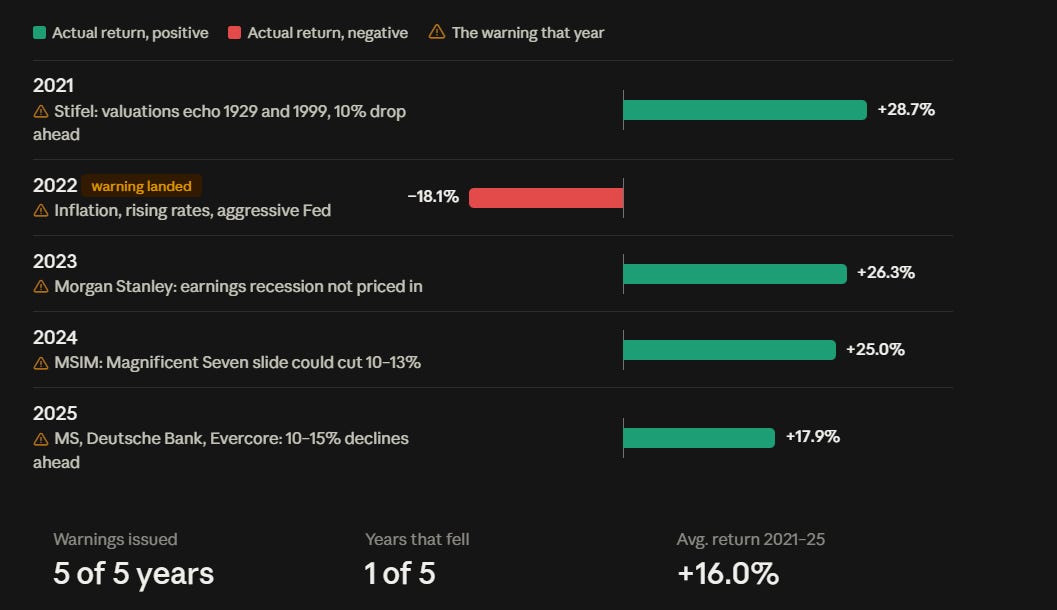
In April 2021, Stifel’s chief equity strategist Barry Bannister warned that the S&P 500 could fall 10% between May and October. In his view, valuations had reached levels previously seen around 1928-29 and 1998-99, and rising real yields could pressure multiples lower.
That does not sound unreasonable.
But the S&P 500 finished the year with a 28.7% total return.
In 2022, the main concerns were inflation, rising interest rates, and an aggressive Federal Reserve.
This time, the pessimists were much closer to being right.
The S&P 500 fell 18.1%, including dividends.
Then came 2023.
Morgan Stanley’s Mike Wilson argued early in the year that an upcoming “earnings recession” had not been priced into the stock market. The bank pointed, among other things, to expected earnings growth turning negative, which historically had been associated with significant further downside in equities.
Again: a perfectly legitimate argument.
The S&P 500 ended the year up 26.3%.
In 2024, one of the major concerns had become the market’s concentration around the largest US technology companies. Morgan Stanley Investment Management warned that a decline in the Magnificent Seven could send the US market down between 10% and 13%. US equities were expensive, and the rally was highly concentrated.
The S&P 500 finished the year up 25%.
In August last year, we were there again.
Morgan Stanley, Deutsche Bank, and Evercore all warned about declines in the months ahead. Their forecasts were generally in the 10-15% range. High valuations were expected to collide with weaker economic data, inflation risks, and softer employment growth.
The S&P 500 finished 2025 with a 17.9% total return.
The numbers are fairly striking:
And now it is August 2026.
Once again, there are plenty of good reasons to worry: interest rates, debt, AI spending, valuations, geopolitics, market concentration.
The interesting question is not whether some of these concerns will eventually prove justified. Some of them almost certainly will.
The interesting part is this:
There has almost always been a convincing reason to worry. Still, over time, markets climb.
Risk Is Not the Same as a Sell Signal
I am not saying that we should laugh at these forecasts. After all, 2022 happened. And the financial crisis happened. The dot-com bubble burst. Covid sent markets straight down for a (short) while.
Risk is absolutely a real thing.
The problem begins when our brains translate “This is a risk” into: “Therefore I should sell my stocks.”
Those are two very different conclusions.
An analyst can be completely right that the stock market is expensive, that investors are overly optimistic, or that the economy faces significant risks.
But for that observation to be useful to you as an investor, the analyst also has to be reasonably right about timing as well.
And we both know this: That is much harder.
You can be entirely correct that the market is expensive, sell your stocks, and then watch equities rise another 30%, 50%, or 100% before the correction you were waiting for finally arrives.
And when it does arrive, the market may still be trading above the level where you sold.
Identifying risk and timing the market are two separate skills. We often confuse them.
A Correction Is Not an Extraordinary Event
There is another data point I think every investor should know.
J.P. Morgan Asset Management has studied the S&P 500 going back to 1980.
Between 1980 and 2025, the average largest decline during a calendar year was roughly 14.2%.
And yet the market still ended the year positive in 35 out of 46 years.
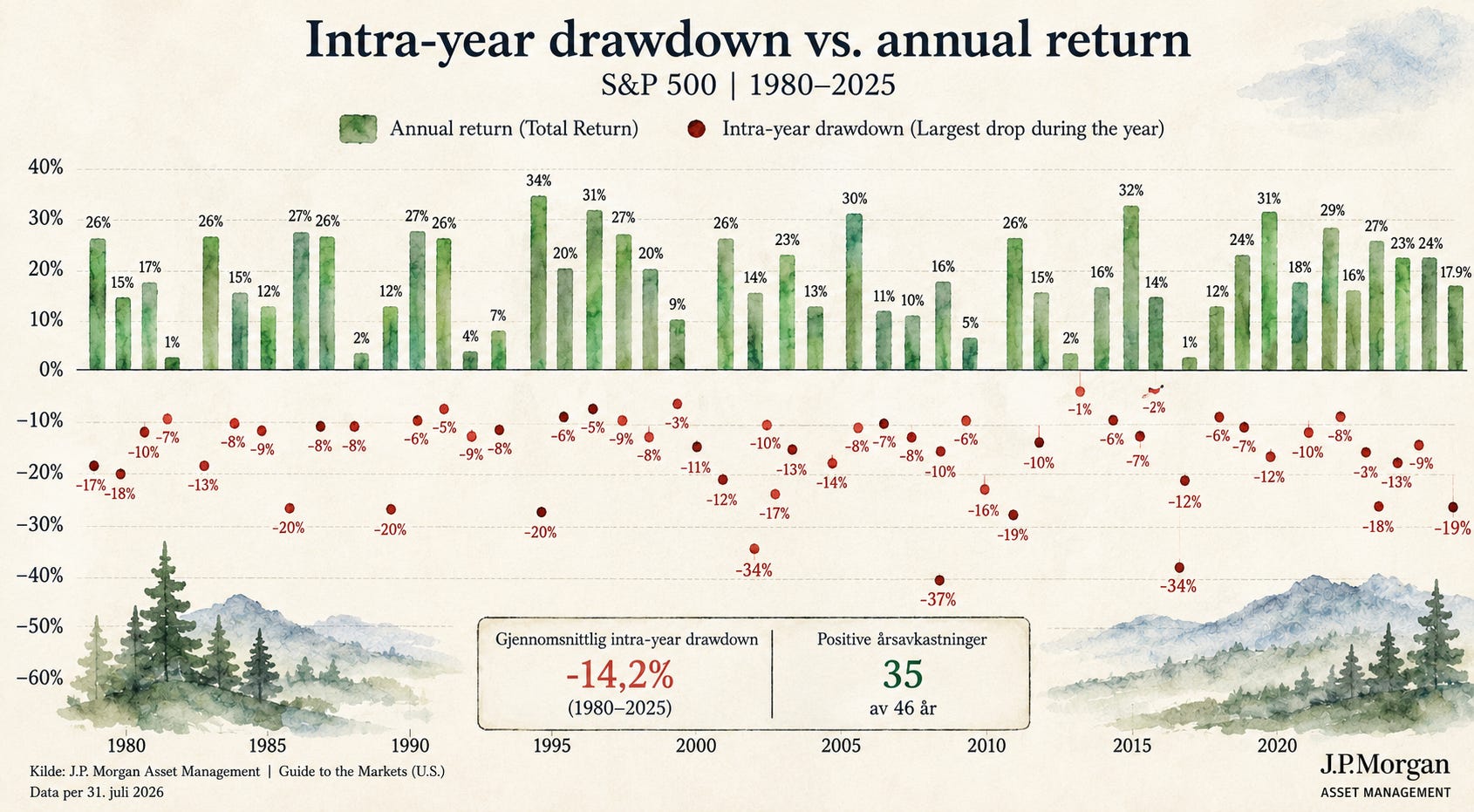
Those two numbers together tell you a lot.
An average intra-year drawdown of around 14%. And nearly three out of four calendar years still finished positive.
That gives very different context to the next headline saying:
“Strategist warns of a possible 10-15% market decline.”
For a newspaper, 15% sounds dramatic.
For a long-term equity investor, a temporary 15% drawdown is a non-avoidable part of the whole game.
We still have no idea when it will happen, corrections can obviously run deeper than 15%, and the market can certainly crash. But significant drawdowns along the way are a completely normal part of earning the stock market’s long-term returns.
The Problem With Noise
I am extremely focused on avoiding noise as an investor.
Ideally, I want as little of it as possible.
I do not need to know what the market did during the first 40 minutes after the open. Or need an explanation for why the Nasdaq fell 1.4% on a Tuesday. And I am very unlikely to become a better owner of a business by consuming five strategists’ opinions about what the S&P 500 will do over the next three months.
But it is of course impossible to shield yourself completely.
The headlines will reach you. You see them in newspapers. On X. In your Substack feed. On CNBC. In podcasts. In group chats. From colleagues. And so on.
And that creates another problem.
Frequency starts to feel like evidence.
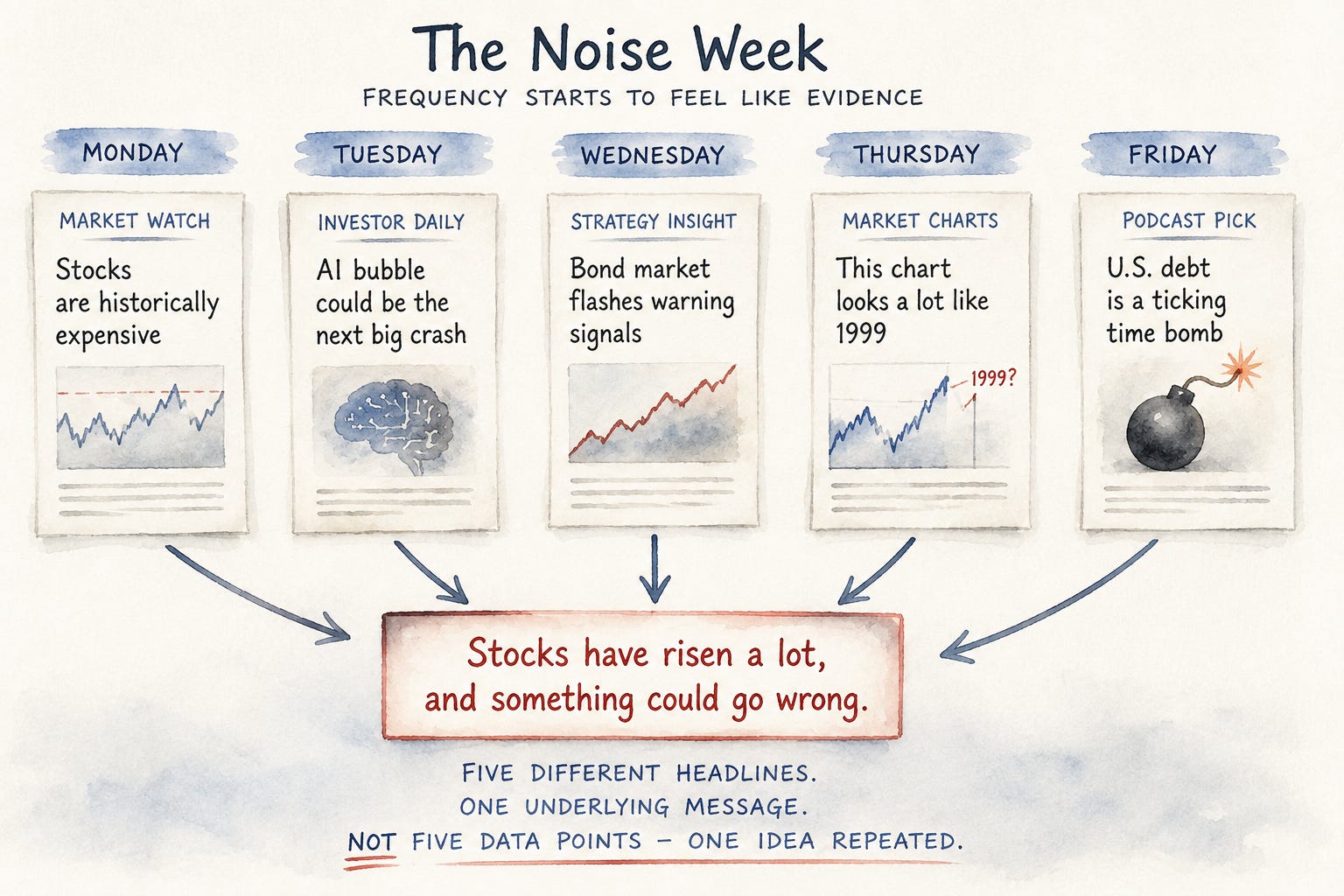
Imagine that over the course of one week you encounter the following:
On Monday, you read that the stock market is historically expensive.
On Tuesday, a well-known investor warns about an AI bubble.
On Wednesday, a strategist tells you that the bond market is flashing warning signs.
On Thursday, a chart appears on X comparing today’s market to 1999.
On Friday, you listen to a podcast about US government debt.
It feels like five different data points.
But is it really?
Maybe you have simply been exposed five times to variations of the same underlying idea:
Stocks have risen a lot, and something could go wrong.
We are pretty bad at distinguishing between how often we hear something and how much new information we have actually received.
When the same concern is repeated often enough, it begins to feel more true.
Noise has a cumulative effect. A single article rarely changes your mind. But a hundred small exposures can gradually make you more defensive, even though the fundamental assumptions behind your investments may have stayed exactly the same.
History Works Like a Mental Vaccine
This is where knowledge of history becomes useful.
The goal: stop overreacting to normal risk, while still taking real risk seriously.
When I know that the market has historically experienced substantial drawdowns during otherwise normal and profitable years, I interpret a warning about “10% correction risk” differently.
When I know there were highly plausible reasons to sell in 2021, 2023, 2024, and 2025, I interpret today’s plausible reason differently too.
It might still turn out to be right. But now I know the base rate, and that changes how much weight I give it.
That makes an enormous difference.
Let’s use airplanes as an example: the aircraft is experiencing turbulence. If you have never flown before, it may feel like a warning sign.
If you know that turbulence happens on thousands of flights every day without the planes crashing, you interpret the same information differently.
You are simply working with better context.
The same applies to markets.
“This Time Is Different”
The difficult part, of course, is that every period actually is different.
The dot-com bubble looked nothing like the financial crisis. The financial crisis looked nothing like Covid. Covid looked nothing like the inflation shock. And the AI boom is far from a carbon copy of the dot-com era.
History never repeats perfectly.
That is precisely why the argument “this time is different” is so powerful.
Because it is always partly true.
But from an investment perspective, there is still one remarkable constant:
The future has always been uncertain.
Think about what investors have had to sit through over just the past 25 years: the dot-com collapse, September 11, wars, the financial crisis, the euro crisis, Brexit, trade wars, a global pandemic, supply-chain disruption, inflation, the fastest interest-rate increases in decades, war in Europe, new conflicts in the Middle East, banking turmoil, AI fear, AI euphoria, and debt concerns.
And throughout all of it, some of the world’s best companies continued to sell more products, grow earnings, repurchase shares, and create enormous value for their owners.
There was never a point when being a long-term investor felt obviously safe.
The past looks safe in hindsight because we know how it ended.
While we were living through it, the outcome was unknown.
The Only Question I Really Need to Ask
That is why I try to shift my attention away from “What will the market do?” toward:
“What has actually changed?”
If I own a company, I am far more interested in questions like:
Has its long-term earnings power weakened?
Has the balance sheet become more dangerous?
Is the competitive advantage disappearing?
Has management started allocating capital poorly?
Has the company’s market become structurally worse?
Am I paying a price that requires unrealistic expectations?
Those are risks I want to spend time thinking about.
Whether the S&P 500 might fall 12% this autumn is much harder for me to do anything useful with.
In fact, such a decline could be positive if the businesses I want to own continue to perform well.
I simply get to buy more of the same future cash flows at a lower price.
My Noise Filter
I therefore think I will use a simple filter the next time a dramatic market warning appears.
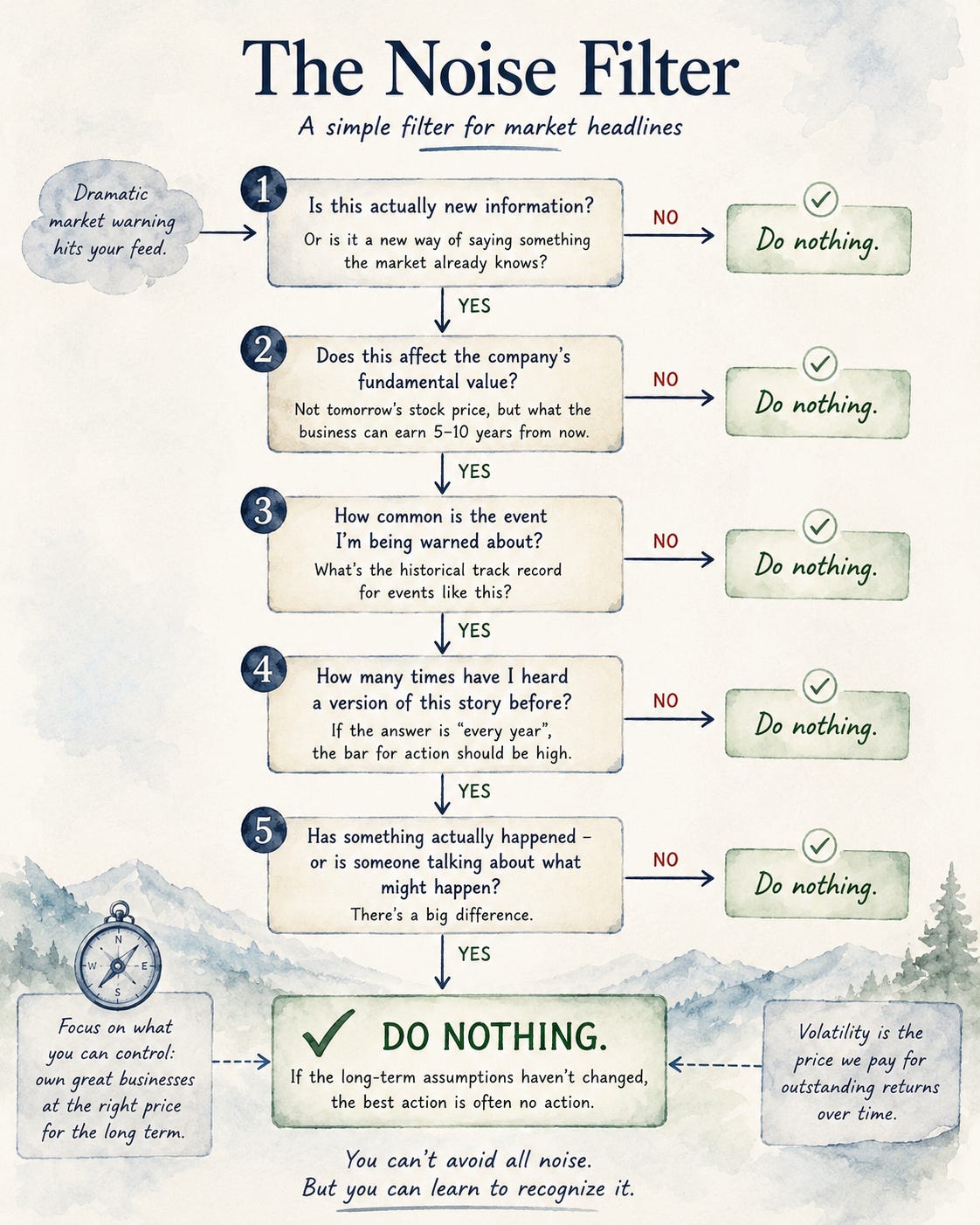
1. Is this actually new information?
Or is it just a new formulation of a risk the market already knows about?
2. Does this affect the company’s fundamental value?
I care less about tomorrow’s stock price and more about what the business is likely to earn five or ten years from now.
3. How common is the event I am being warned about?
A potential 10-15% decline sounds different when I know how frequently such drawdowns have historically occurred.
4. How many times have I heard a version of this story before?
If the answer is “every year,” the hurdle for taking action should be high.
5. Has something actually happened, or is someone talking about what might happen?
That distinction matters.
And if, after asking those questions, I conclude that the long-term assumptions have not changed?
Then the best option is often the simplest one:
Do nothing.
Wall Street Will Always Be in Danger
One day, one of these warnings will hit the bullseye. I am pretty sure of that.
We will have new bear markets. New recessions. New bubbles. New crises that none of us manage to predict.
But you will probably read a hundred warnings before you encounter the one warning you truly should have acted on.
And that is exactly why noise is so freaking difficult.
The real danger is that a warning can be intelligent, plausible, and even correct, and still be completely useless to your investment decision.
There will always be a reason to sell stocks.
When inflation disappears, recession fears take its place.
When the recession fails to arrive, valuation becomes the problem.
When earnings grow into those valuations, market concentration becomes the issue.
When market breadth improves, interest rates become the concern.
When interest rates fall, we worry that they are falling because the economy is weakening.
The narrative keeps changing, but the worry always finds a new home.
That is why I do not think the solution is to consume enough information to eliminate uncertainty, but to understand how markets have actually behaved in the past, identify which risks truly affect the value of what you own, and accept the rest as part of the game.
You cannot always avoid noise, but you can learn to recognize it.
If you made it this far, you probably think about investing the same way I do.
Atomic Moat exists to be the opposite of the noise we just talked about. No market predictions, no weekly panic, no hot takes about what the S&P 500 will do this fall. Just deep, patient work on great businesses.
Paid subscribers get everything I produce:
Deep Dives on individual companies, where I run them through the full framework: the moat, the balance sheet, the cash flow engine, and the price I am willing to pay.
My full portfolio, updated monthly, including every buy, every sell, and my honest reasoning behind each move. When I make a mistake, you read about that too.
My watchlist with fat pitch targets: the exact prices where I believe great companies become great investments. So when the next 15% drawdown arrives, you already know what to do with it.
The whole point of this article was that most market information is useless to you. My goal is that everything behind the paywall is the opposite.
Danger’s my middle name
The intra-year drawdown of the S&P500 was not -9%, it was way more, roughly -19%