



If you look at the track record of Princeton Newport Partners (PNP) from 1969 to 1988, you will see something that shouldn’t exist.
Over nearly 20 years, the fund delivered an annualized return of roughly 19%. That is impressive, but not unique. What makes it a statistical anomaly is the downside:
There wasn’t any.
In two decades of operation, through the inflation of the 70s and the Crash of 1987, Edward O. Thorp had zero down years.
But Thorp is not just a financial outlier. He is a biological one. At age 93, he weighs 155 pounds; exactly what he weighed when he was 17 years old. While most billionaires sacrifice their health for their wealth, Thorp applied his probability theory to his own biology.
He is the Godfather of Quantitative Finance, the man who beat the dealer, and perhaps the only investor who has figured out how to compound both money and life expectancy.
The Origin Story: The Professor Who Hated “Luck”
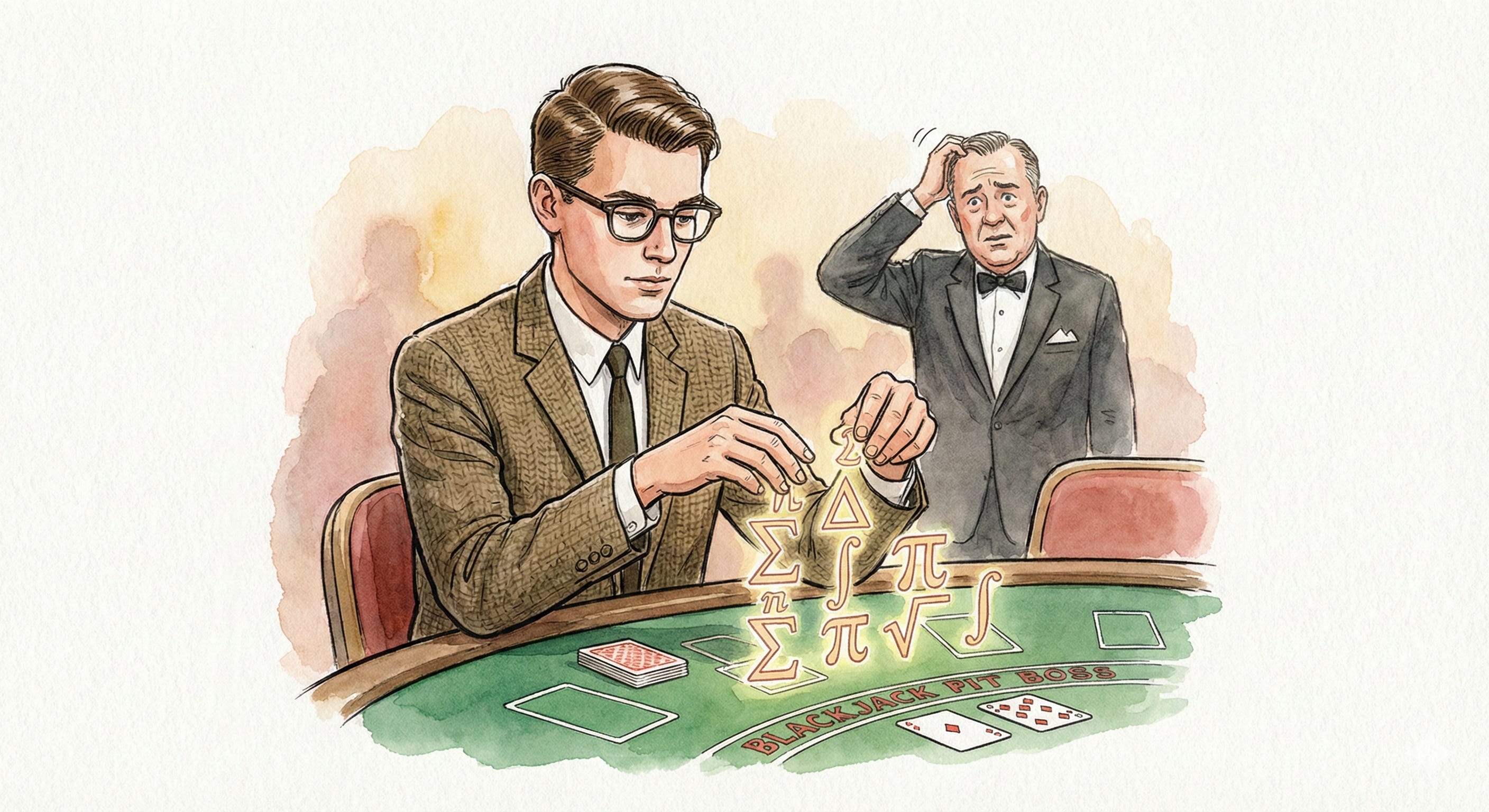
Edward Thorp didn’t start on Wall Street. He started at MIT.
In the late 1950s, Thorp was a young math professor with an itch. The world believed that gambling was a game of pure chance. That you couldn’t beat the house.
Thorp believed that was nonsense. He treated the casino not as a temple of luck, but as a math problem waiting to be solved.
He didn’t rely on superstition. He used an IBM mainframe to run thousands of simulations on Blackjack hands. He discovered that when certain cards were removed from the deck (specifically low cards), the odds shifted mathematically in favor of the player.
In 1962, he published Beat the Dealer, the book that introduced card counting to the world and forced multi-billion dollar casinos to change their rules forever.
But he didn’t stop at cards. In 1961, teaming up with Claude Shannon (the father of Information Theory), Thorp built a cigarette-pack-sized computer to predict the motion of a roulette ball. He wore it into casinos, effectively creating the world’s first wearable computer, giving him a 44% edge over the house.
Thorp realized that if he could find a mathematical edge in the chaotic randomness of a roulette wheel, he could certainly find one in the pricing of financial derivatives.
The Superpower: Market Neutrality (The “Risk-Free” Trade)
Most investors try to predict the future. They guess if Apple will go up or down.
Thorp’s superpower was that he didn’t care what the future held. He didn’t pick stocks; he picked mispricings.
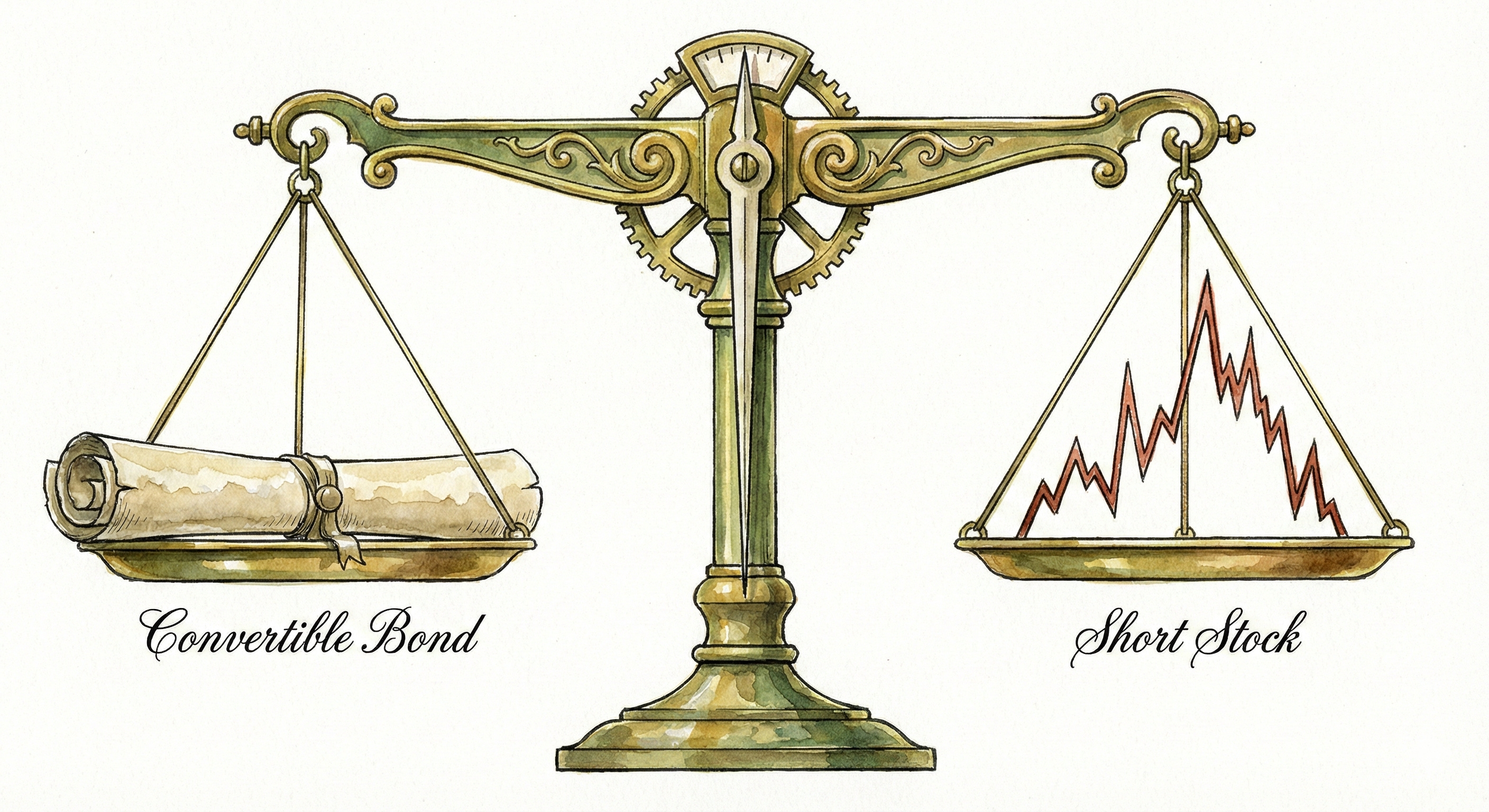
He pioneered a strategy called Convertible Arbitrage.
The Mechanic: Thorp would buy a convertible bond (a bond you can trade for stock) that was cheap, and simultaneously short the underlying stock that was expensive.
The Result: If the stock went up, his bond gained value. If the stock went down, his short position made money. He locked in the spread between the two prices.
He derived the formula for pricing options years before Black and Scholes published their Nobel Prize-winning paper. While the rest of Wall Street was guessing, Thorp was using a “secret formula” to buy dollars for 50 cents.
He wasn’t betting on the horse; he was betting on the discrepancies in the betting slips.
(While Thorp mastered the individual 'bet,' understanding how those bets interact within the broader economic cycle is best explored through Ray Dalio’s framework on the Economic Machine.)
The Graveyard: The Man Who Saw Through Madoff
Thorp’s “Graveyard” isn’t his own failure; it is the failure of others that he predicted.
Because Thorp views the world through the lens of “statistical impossibility,” he is the ultimate fraud detector. In the early 1990s, a large client asked Thorp to review the portfolio of a money manager who was delivering incredibly steady returns.
That manager was Bernie Madoff.
Thorp analyzed the trade logs. He looked at the options volume. He ran the math. He realized that for Madoff to achieve those returns with that specific strategy, he would have had to execute more volume than existed in the entire stock exchange.
Thorp declared the returns “statistically impossible” and a fraud. He warned his clients to get out. It would take the SEC another 17 years to catch up to Thorp’s math.
Thorp proves that if you understand the mechanism, you cannot be conned by the narrative.
Steal Their Brain: The Thorp Protocol
You don’t need a PhD in mathematics to use Thorp’s operating system. Here is the toolkit:
1. The “Defense” Framework (Health as a Portfolio) Thorp treats his body like a hedge fund. He categorizes health into “Defense” (avoiding ruin) and “Offense” (optimizing performance).
The Actionable Rule: Treat medical risks like market drawdowns—unacceptable if they can be hedged. Thorp undergoes rigorous annual testing to catch “weak links” (like cardiovascular markers) early. When he discovered he had osteopenia (bone density loss) in his 60s, he didn’t accept it as “aging.” He attacked it with Vitamin K, D, and weight-bearing exercise, successfully reversing the condition. Don’t wait for symptoms; hunt for the data.
2. The Kelly Criterion (Bet Sizing is Everything) Thorp didn’t just know how to bet; he knew how much to bet. He used the Kelly Criterion to maximize growth while avoiding ruin.
The Actionable Rule: Your edge doesn’t matter if you bet too big and go broke on a bad run. If you have a high conviction trade, bet big. If you have low conviction, bet small. Most investors bet huge on low-conviction ideas. Match your position size to your probability of winning.
3. The “Benjamin Button” Standard Thorp believes that “sugar and processed foods” are the biological equivalent of toxic subprime mortgages—long-tail risks that blow up your system.
The Actionable Rule: Thorp weighs 155 lbs—the same as he did at 17. He fights the “creep” of 1-2 pounds per year. Set a “hard stop” on your weight, just like a stop-loss on a stock. If you breach it, immediate correction is required.
The Human Factor: The 93-Year-Old Athlete

It is easy to picture the “Quant” as a pale guy behind a screen. Thorp is the opposite.
He views exercise as the single highest-ROI investment available to a human being. For decades, he ran marathons (completing over 20 of them). As he aged, he rationally pivoted. Realizing that running might destroy his joints (a depreciating asset), he switched to rigorous walking and hiking.
He fights sarcopenia (muscle loss) with the same intensity he fought casinos. He lifts weights regularly, focusing on core strength.
He is 93. He can still do chin-ups and push-ups—feats that many 40-year-old finance professionals cannot perform. To Thorp, physical vitality isn’t vanity; it’s the battery that powers the brain.
The Verdict
Edward O. Thorp is the ultimate rationalist. He proved that the “House” (whether a casino or Wall Street) can be beaten if you refuse to play by their emotional rules.
Copy this style if:
You love Logic: You trust data over “gut feel” or CEO interviews.
You hate Drawdowns: You are willing to accept slightly lower upside to ensure you never lose money.
You play the Long Game: You view your health and your wealth as a 50-year compound interest project.
Run away if:
You crave Action: Thorp’s investing is often boring arbitrage. It lacks the dopamine hit of a “moonshot.”
You lack Discipline: Whether it’s cutting sugar or cutting a losing trade, Thorp’s method requires zero emotional deviation.
Thorp teaches us a simple truth: The majority is usually wrong because the majority relies on emotion. If you can strip away the fear and greed, and simply look at the math, you can win the game.
An extremely interesting guy to study and even copy some of his ideas.